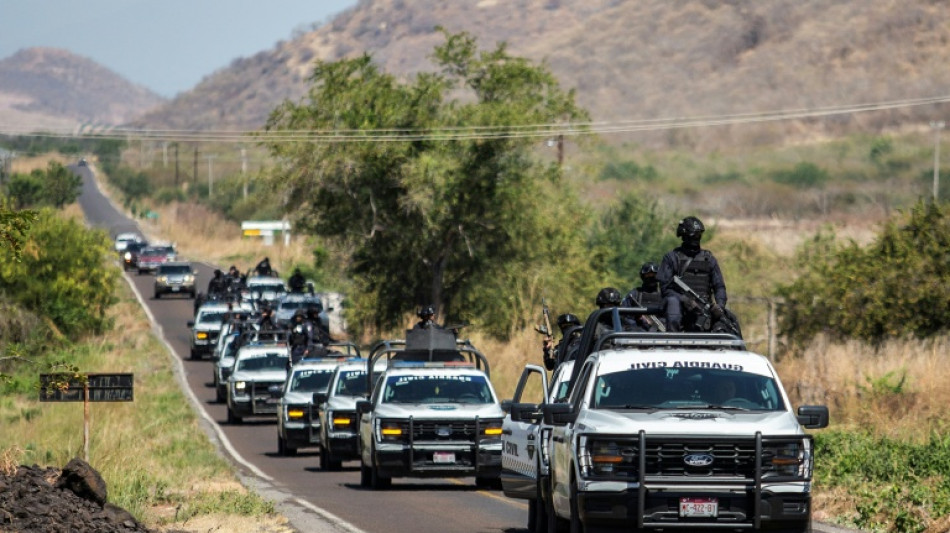
TikTok disinformation: the other weapon in Mexico violence / Photo: Enrique Castro - AFP

While gunmen for the powerful Mexican narcotrafficker Nemesio "El Mencho" Oseguera were burning vehicles and blockading roads across Mexico in response to the killing of their leader, others stoked chaos through different weapon: disinformation.
The death of the most-wanted Mexican narco, the leader of the Jalisco New Generation Cartel (CJNG), in a military operation on Sunday unleashed a wave of criminal violence in 20 out of 32 states.
It also unleashed the mass dissemination of AI-created images shared thousands of times on social media.
The fact-checking team for AFP in Mexico analyzed a dozen of the fake images and videos linked to the operation and its fallout that were shared over 38,500 times on social media.
One of the most disseminated was an aerial image -- made with artificial intelligence -- of Puerto Vallarta, the tourist paradise on the Pacific coast of the western state of Jalisco, that showed multiple buildings in flames.
The henchmen of "El Mencho" did burn vehicles and vandalize businesses in the famous beachside resort town. But the damage wasn't of the magnitude that the false photographs showed.
- 'Magnifying the chaos' -
Behind this digital mobilization, according to multiple analysts, are accounts tied to Oseguera's CJNG.
Alberto Escorcia, a journalist specialized in social media, identified three groups that disseminated false information tied to the wave of violence.
"One was the Jalisco Cartel, magnifying the chaos," he explained to AFP.
Groups of "opportunists" also participated in the disinformation, using them to promote national and international political talking points, he added.
Multiple of these "opportunistic" accounts have already been identified by AFP as disseminators of disinformation in Mexico and the rest of Latin America.
Escorcia was threatened on social media after he shared a video where he demonstrated the disinformation on the platform X during the chaotic morning.
Mexico's security secretary, Omar Garcia Harfuch, claimed that there are "multiple accounts" on social media identified by his office as engines of disinformation tied to the operation.
"We're going to do a deeper job to find out what relationship they have to the criminal organization," while others "were only dedicated to disinformation," he said in a press conference.
- Recruitment-
Academic researchers also detected expressions of sympathy for Oseguera, who until his killing was the most wanted narco in the United States, where the government offered a 15 million dollar compensation in exchange for information leading to him.
"There was a notable and sustained volume of publications and comments with expressions of admiration, mourning," and "aspirational identification" with the druglord, according to Valeria Almaguer, the subdirector of the Seminar on Violence and Peace at the College of Mexico.
This group of investigators, examining Instagram, TikTok, and X, found messages that lamented the death of "El Mencho," accompanied by emojis tied to the CJNG and "narco-corridos," popular songs that celebrate criminal groups.
These symbols coincide with the seminar's findings in an investigation that documented the existence of over 100 accounts on TikTok dedicated to criminal recruitment and propaganda.
"The CJNG leads the use of TikTok as a channel of recruitment and propaganda," they published in an April, 2025 report.
The usage of social media by the CJNG to fill their ranks has also been identified by the Security Secretary's Office.
In March, 2025, following the discovery in Jalisco of a training center for the criminal mafia, the department identified 39 profiles dedicated to recruiting young people that TikTok removed at the request of the authorities.
G.Danielsson--StDgbl