Venezuela says Caracas airport to reopen to commercial flights 'soon as possible' / Photo: Miguel MEDINA - AFP

Venezuela's interim President Delcy Rodriguez said on Tuesday the international airport damaged in last month's twin earthquakes would reopen as soon as possible using an alternative runway.
Simon Bolivar International Airport is in La Guaira, north of Caracas and the epicenter of the June 24 quakes that toppled scores of residential buildings and killed nearly 3,700 people.
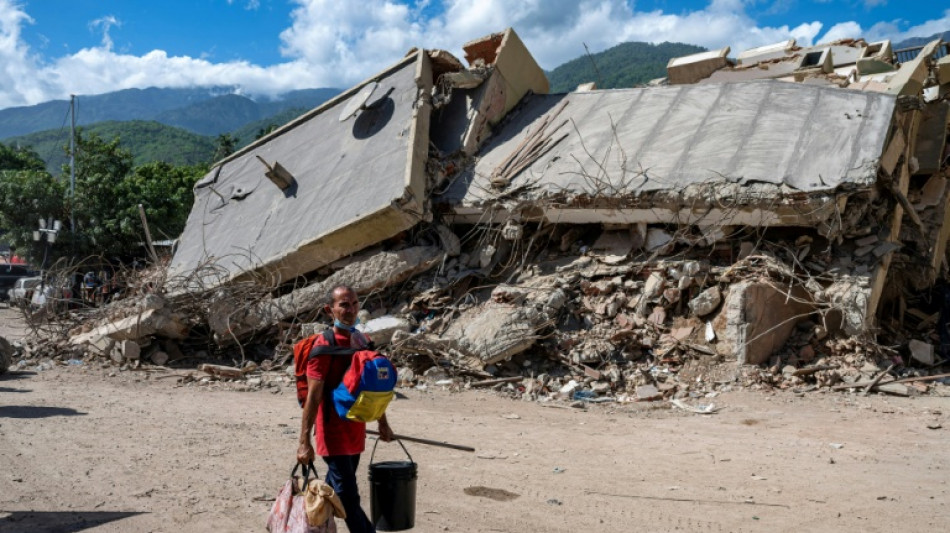
One of Latin America's worst earthquake disasters has left thousands of people homeless and thousands more still missing, especially in badly damaged La Guaira, where families are still digging in the rubble.
The airport has been partially open to humanitarian flights.
"I ordered the immediate activation of an alternative plan to allow commercial flights to resume as soon as possible using the airport's parallel runway," Rodriguez said in a message on her Telegram account.
US airmen and military experts have been helping to reopen the airport and also repair the quake-hit port in La Guaira to facilitate delivery of supplies and equipment.
Speaking to reporters on a conference call, US embassy Charge d'Affaires John Barrett said US officials were already in talks with American commercial airlines to resume flights.
"There is some work to do in terms of the infrastructure to support commercial operations at the airport," he said, without giving a precise date.
US Southern Command chief General Francis Donovan said US military personnel were still assisting with air traffic control and ground cargo operations at the airport.
Around 2,000 US troops have been deployed in Venezuela to help with disaster relief, and US helicopters and planes often land at the airport.
- 'It's my duty' -
Nearly two weeks after the 7.3 and 7.5 magnitude earthquakes, international rescue teams are ending attempts to find survivors while families scour the ruins for the bodies of their loved ones.
The government updated the death toll on Tuesday to 3,685 and said nearly 17,000 were injured.
Rodriguez has defended her government's response to the disaster, although many Venezuelans with relatives missing are angry, saying they were left to dig on their own before international rescue teams arrived.
Thousands of people are now homeless and sleeping in tents outside destroyed buildings or in temporary camps for those who have been displaced.
Outside the Rita Sol Palace building in the Caraballeda area of La Guaira, excavators dig through the ruins in search of bodies.
Lazaro Rubio, 66, lived on the eighth floor. His wife and her two daughters are trapped in the rubble. His 11-year-old stepson survived and is in Caracas.
"We're not leaving here until we recover the bodies," he said. "I'm staying because my wife and two daughters are there... It's my duty."
Two days after the quakes, the United Nations estimated as many as 50,000 people were still unaccounted for, although the government has yet to give any estimate on the number of missing.
Even before the disaster, Venezuela was struggling with economic crisis and political turmoil that left infrastructure and health services depleted.
Rodriguez came to power in January after then-president Nicolas Maduro was captured in a US military operation in Caracas.
The UN estimates the quakes caused $6.7 billion in damage -- equivalent to six percent of the GDP of Venezuela, a major oil producer.
The UN refugee agency has said it needs an estimated $14.85 million to scale up protection, relief items and temporary shelter support for 30,000 earthquake-affected people over six months.
V.Sandberg--StDgbl