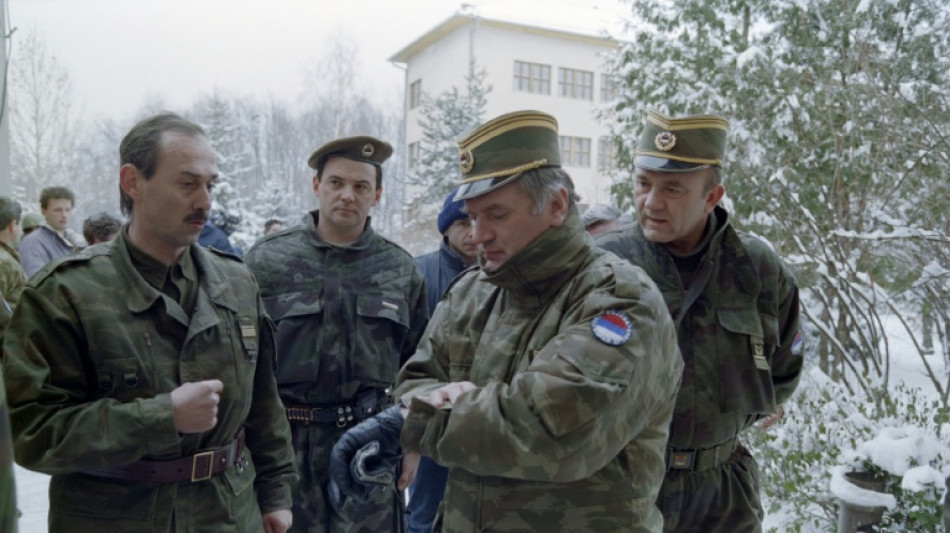
Bosnian Serb war criminal Ratko Mladic dead / Photo: Pascal GUYOT - AFP/File
Ratko Mladic, the former Bosnian Serb military chief who was convicted of war crimes for his role in the 1995 Srebrenica massacre, died in hospital on Thursday, according to a United Nations international tribunal.
Mladic, who had suffered several strokes in recent months, was serving a life sentence in The Hague for genocide, war crimes, and crimes against humanity after overseeing the Srebrenica slaughter, Europe's worst act of bloodshed since World War II.
His conviction for the wartime killings as the former Yugoslavia descended into carnage after the fall of communism led the media to dub him the "Butcher of Bosnia".
The 1992-1995 war left around 100,000 people dead and 2.2 million displaced.
Mladic was the military face of a brutal trio, led on the political side by ex-Yugoslav president Slobodan Milosevic and former Bosnian Serb leader Radovan Karadzic.
Serbian state officials and Mladic's family had appealed for his release due to his failing health, but those calls were rejected by the Hague tribunal.
A representative of the Mothers of Srebrenica victims' association, reacting to the death of Mladic, told AFP that his name would always "symbolise genocide".
"That will never be erased from his name," said Sehida Abdurahmanovic, who believes her missing brother was among those killed in Srebrenica.
- Srebrenica -
In the war's most infamous atrocity, Serb forces under Mladic's command executed 8,000 Bosnian Muslim men and boys who had sought shelter in Srebrenica, which was meant to be a UN-protected enclave.
Their bodies were dumped in mass graves, many of which were dug back up and reburied in order to try to hide the evidence.
The few who escaped told harrowing stories of murder, torture and rape by the Bosnian Serb forces.
In November 1995, the International Criminal Tribunal for the Former Yugoslavia (ICTY) indicted Mladic, who was dismissed from his post but evaded capture for another 16 years.
At first he led a life of luxury, pampered by the military in Serbia where some to this day see him as a hero.
But the pressure mounted on him after Milosevic fell from power in 2000. Mladic was finally arrested in May 2011 and transferred to The Hague.
He was convicted in 2017, with the life sentence upheld on appeal in 2021.
On the streets of Bosnia's capital Sarajevo, Hava Suljic told AFP she welcomed the news.
"I'm delighted to know there is one less war criminal walking around in this world," Suljic, a Bosnian Muslim from Srebrenica, said.
But reactions in the Serb entity of divided Bosnia were in stark contrast.
Former Bosnian Serb leader Milorad Dodik said Mladic's death had "hit hard" and that the Republika Srpska "will not forget his role", the Serb statelet's public broadcaster reported.
Locals who spoke with AFP in the Republika Srpska's capital, Banja Luka, labelled Mladic the "greatest".
"The greatest man has died, the greatest general of the Serbian people," pensioner Dragan Beric said.
- 'Epitome of evil' -
Mladic was also found guilty of orchestrating a wider campaign of ethnic cleansing to drive Muslims and Bosnians out of key areas to create a so-called Greater Serbia.
But many Serbs continued to revere a military commander who painted himself as a "simple man" whom fate had chosen to protect his people.
His age has always been a matter of dispute. He claimed to have been born in March 1943 but the tribunal listed his birth year as 1942 -- local media widely reported that he'd died at the age of 84.
D.Fransson--StDgbl