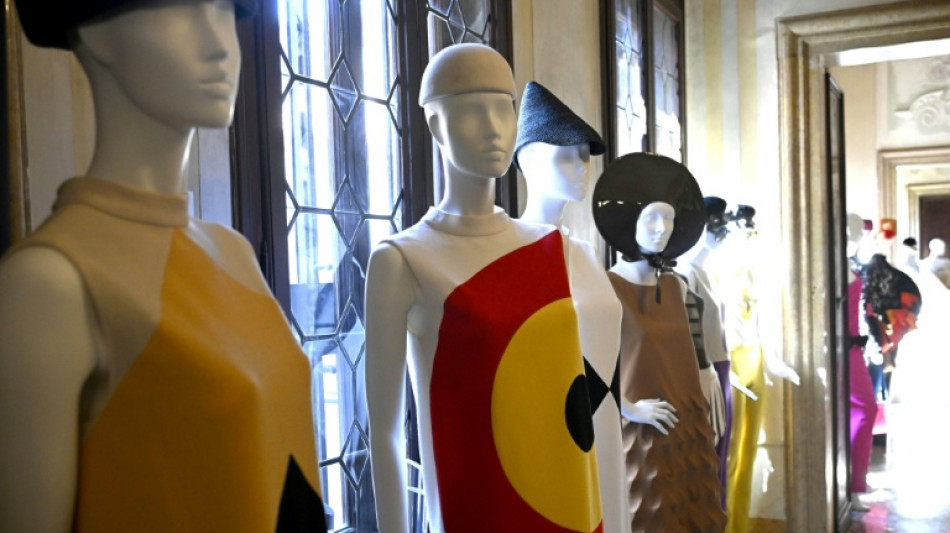
Pierre Cardin museum brings designer's futurist style to Venice / Photo: ANDREA PATTARO - AFP

Hundreds of style-setting creations from the late designer Pierre Cardin will fill his Venice palazzo later this month in a new museum celebrating the cutting-edge vision of fashion's futurist.
A costume ball Thursday evening at Cardin's Venetian home of nearly 40 years, the Palazzo Bragadin, will help kick off the museum opening, scheduled for September 13.
Cardin, the Italian-born French couturier who died in December 2020 at the age of 98, was a stalwart of swinging 1960s fashion with his unisex, space-age designs that created youth-culture shockwaves from the boulevards of Paris to Carnaby Street in London.
Knit minidresses with bold geometric patterns, unexpected cut-outs and a penchant for synthetic fabrics cemented Cardin's reputation as a modernist in tune with the zeitgeist of the decade.
Cardin used his palazzo in Venice, which he bought in 1981, as a retreat and a place to refuel his imagination, said his nephew, Rodrigo Basilicati-Cardin, chief executive of the label, whose creative atelier remains in Paris.
"I thought, 'This was his home, what better place?' There is an almost 1,000-square-metre space, with important ceiling heights, what better setting to display at least a hundred outfits?" he said during a tour of the exhibition space.
Today, Cardin is largely remembered for the pioneering business strategy of licensing his name around the world to thousands of products, from bedsheets to answering machines -- one that made him rich, but took some of the lustre off his once-coveted brand name.
Today, the company has about 130 products licensed.
The museum seeks to remind viewers of the innovative design sensibility of the couturier, who worked under Elsa Schiaparelli and Christian Dior in Paris before launching his own line in 1950.
Cardin sought to democratise fashion through the launch of a ready-to-wear line in 1959 -- a shocking concept at the time that got him temporarily kicked out of the French haute couture governing body -- but which was quickly copied by rivals.
Around 130 outfits fill the sumptuous rooms of the palazzo, ranging from 1951 to 2018: here an emerald green knit belted tunic with dramatic cut-outs at the sides from 1971, there a 1991 black velvet evening gown adorned with an oversized taffeta rose at the hips.
A 1963 sleeveless minidress in silver silk with a honeycomb pattern has a bow at the neck serving as a collar, while a 1993 dress in pumpkin and black features dramatic pleats flowing from the bodice.
Basilicati-Cardin said that for his uncle, the body was secondary to what it supported -- the sculpture of the clothing.
"His entire life was based on structures; all his garments are architectural, nothing purely fluid," he said.
"He considered his dresses as sculptures."
At heart, Cardin was a minimalist.
"He was always the person who said: 'I want them to recognise my dress from 10 metres away,'" he said.
"Few ideas, two at most, preferably of different kinds -- one of form, one of colour -- and that’s it. A minimum of concepts."
- Twist of fate -
Thursday's costume ball comes 75 years to the day after a legendary ball at a nearby palazzo that helped launch Cardin's career.
Dubbed the "Ball of the Century", the 1951 party thrown by socialite art collector Charles de Beistegui was attended by the Who's Who of society -- including Orson Welles, the Aga Khan III and photographer Cecil Beaton, who took many pictures.
Just after Cardin left Dior, the great couturier gave his former assistant a commission to create about 30 costumes for an upcoming ball in Venice that he did not have the time to do himself -- a twist of fate that helped kickstart the young designer's reputation.
"You have to imagine my uncle, four months after opening his 'maison', finding himself with an order to create 30 important costumes. At that time he had only six workers, six seamstresses, and he produced these 30 costumes, including those for Salvador Dali and his friends," his nephew said.
Arranging last-minute details on Thursday for the upcoming museum opening was Renee Taponier, 79, who began working with Pierre Cardin at age 14.
"I miss him," Taponier told AFP.
"You see, he shaped me. He built my whole life."
In her more than 60 years with the company, Taponier has sewn, worked in sales and helped organise fashion shows, among many other jobs.
"He was a man who demanded a lot, but who gave us a lot as well."
D.Fransson--StDgbl