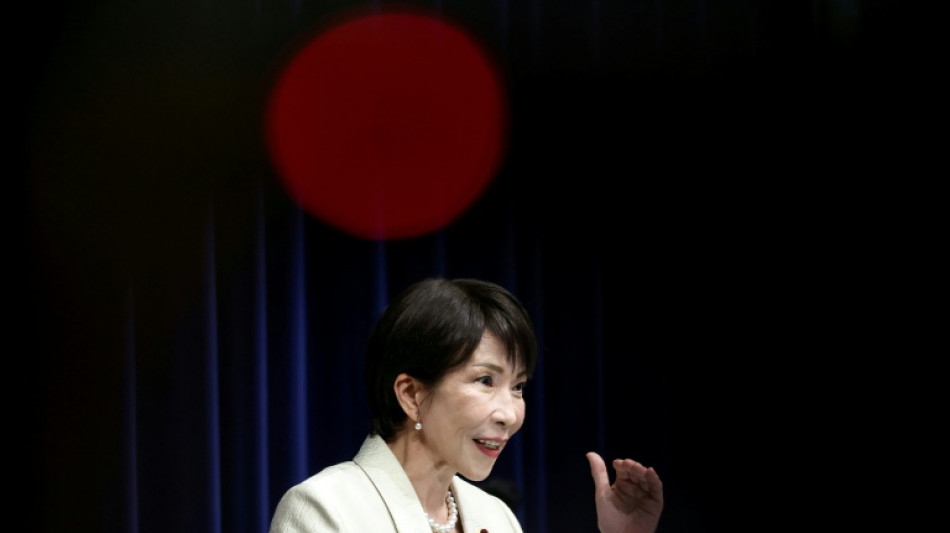
Japan inflation eases in welcome news for PM Takaichi / Photo: Kiyoshi Ota - POOL/AFP



Japanese inflation slowed in January, government data showed Friday, in welcome news for Prime Minister Sanae Takaichi after her recent election landslide win.
Soaring inflation in Asia's number-two economy -- after decades of flat or falling prices -- contributed to the downfall of Takaichi's two predecessors and Japan's first woman premier has made helping households a priority.
Excluding fresh food, "core" consumer prices rose 2.0 percent year-on-year, the slowest rise in two years, down from 2.4 percent in December, and in line with market forecasts.
Also stripping out energy prices, inflation mellowed to 2.6 percent from 2.9 percent, while headline unadjusted inflation was 1.5 percent, down from 2.1 percent.
Petrol prices fell 14.6 percent, thanks in part to government subsidies, but food excluding fresh produce rose 6.2 percent. Rice prices -- which doubled last year -- soared 27.9 percent.
"Looking ahead, we expect headline inflation to weaken further to just over 1 percent in February and March as generous energy subsidies kick in," said Abhijit Surya at Capital Economics.
He added that with price pressures easing, the Bank of Japan "won't be in a rush" to hike interest rates but will still do so by mid-year.
- Godzilla-sized debts -
Takaichi was due to give a policy address in parliament later on Friday after winning a historic two-thirds majority in February 8 snap elections.
A poll by the Yomiuri newspaper published Friday put support for Takaichi's cabinet at 73 percent, up six percentage points and her highest yet.
In the address, Takaichi will likely repeat her campaign pledge to suspend consumption tax on food for two years to help households cope with inflation.
This has exacerbated market worries about Japan's Godzilla-sized debts, with yields on long-dated government bonds hitting record highs last month.
To ease such concerns, Takaichi on Wednesday repeated her mantra of having a "responsible, proactive" fiscal policy and promised to reduce debt.
She will also announce in her policy speech a cross-party "national council" to discuss taxation and how to fund ageing Japan's ballooning social security bill, media reports said.
- Pacific strategy -
But Takaichi's first order of business will be obtaining approval for Japan's budget for the fiscal year beginning on April 1 after the process was delayed by the election.
She is also expected to announce that the government wants to update Japan's 10-year-old "Free and Open Indo-Pacific" (FOIP) strategic framework.
"The international situation surrounding Japan and its security environment are growing increasingly severe," Foreign Minister Toshimitsu Motegi said Thursday.
"Furthermore, new challenges have emerged in economic security and international competition over emerging technologies," Motegi told reporters.
He said the focus of the changes would be to reflect the increased importance of ensuring "resilient supply chains" of items like critical minerals.
In addition it would cover the capacity of nations in the region to safeguard maritime security, Motegi said.
This is a nod to China, which is beefing up its military and is enbroiled in several territorial disputes, including with Japan.
Takaichi, seen before becoming premier as a China hawk, suggested in November that Japan could intervene militarily if Beijing sought to take Taiwan by force.
China, which regards the democratic island as part of its territory and has not ruled out force to annex it, was furious.
Beijing's top diplomat Wang Yi told the Munich Security Conference on Saturday that forces in Japan were seeking to "revive militarism".
Takaichi was also expected to announce plans to create a powerful new National Intelligence Agency that will consolidate information collected currently by different government bodies.
The new agency, along with a mooted new "spy prevention" law, has however raised some concerns.
The new agency "is intended to respond to an increasingly unstable international situation, but it must not be allowed to unjustly infringe upon citizens' rights", the Mainichi Shimbun said in an editorial Friday.
L.Holmgren--StDgbl