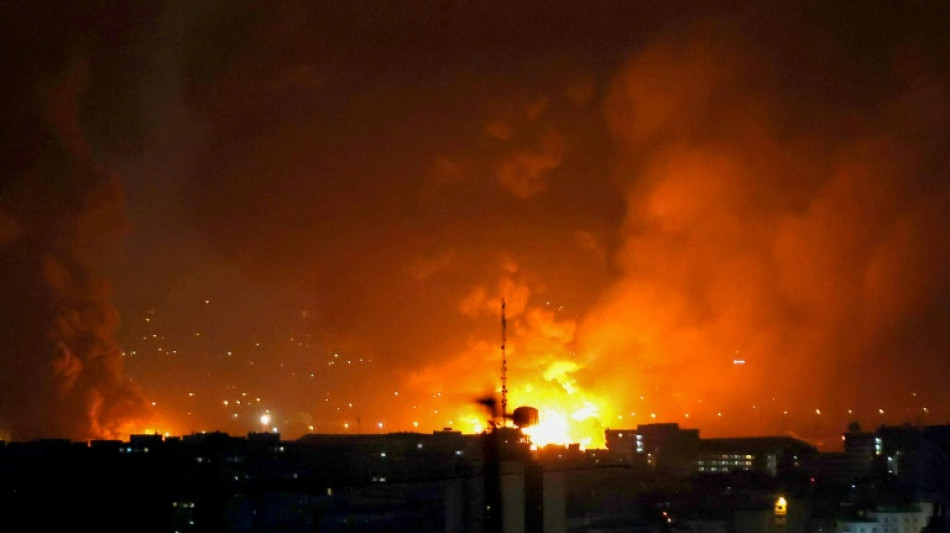
Questions over AI capability as tech guides Iran strikes / Photo: ATTA KENARE - AFP



The latest bout of fighting between the United States, Israel and Iran has seen AI deployed as never before to sift intelligence and select targets, although the technology's use in war remains hotly debated.
Different forms of artificial intelligence have reportedly been used to guide the Israeli campaign in Gaza and the capture of Venezuelan leader Nicolas Maduro in an American raid.
And experts believe the technology has helped select targets for the thousands of US and Israeli strikes on Iran since February 28 -- although exact uses have yet to be confirmed.
Today "every military power of any significance invests hugely in military applications of AI," said Laure de Roucy-Rochegonde of French think tank IFRI.
"Almost any military function can be boosted with AI," from "logistics to reconnaissance, observation, information warfare, electronic warfare and cybersecurity," she added.
AI tools can also be found built into semi-autonomous attack drones and other weapons.
But one of their best-known uses is in shortening the so-called "kill chain", the time and decision-making between detecting a target and striking it.
US forces use the Maven Smart System (MSS) built by Palantir, which the company says can identify and prioritise potential targets.
The Washington Post reported this week that Anthropic's Claude generative AI model has been integrated with Maven to boost the tool's detection and simulation capabilities.
Palantir and Anthropic did not respond to AFP's requests for comment.
AI algorithms "allow us to move much faster in handling information, and above all to be more comprehensive," said Bertrand Rondepierre, head of the French army's AI agency AMIAD.
The technology can sift through vast quantities of data, including "satellite images, radar, electromagnetic waves, sound, drone images and sometimes real-time video," he added.
- Human control -
AI's deployment in war poses a slew of moral and legal questions, notably on the extent of human control over their actions.
The debate was brought to the fore during the fighting in Gaza, where Israeli forces used a programme dubbed "Lavender" to identify targets -- within a certain margin of error.
That application worked "because it covered a very limited area", de Roucy-Rochegonde said.
Israel also has a "mass surveillance system" that could feed data about the enclave's inhabitants into Lavender.
"It seems less likely that such a system has been set up in Iran," she added.
"If something does go wrong, then who's responsible?" Peter Asaro, chair of the International Committee for Robot Arms Control (ICRAC), said in an interview with AFP.
The widely reported bombing of an Iranian school -- which authorities there say killed 150 people -- could be a case of mistaken AI targeting, he added.
Neither the United States nor Israel has acknowledged responsibility for the strike.
AFP was unable to reach the scene of the school to verify what happened there.
But the site was close to two facilities controlled by the Islamic Revolutionary Guard Corps (IRGC), Tehran's powerful ideological elite.
"They didn't distinguish it from the military base as they should have, (but) who is they?" he asked -- human or machine?
If AI was used, he argued that the key question is "how old was the data" used for the targeting, and whether the misdirected strike stemmed from "a database error".
- Step by step -
Rondepierre said that AIs "operating without anyone being in control" are "science fiction".
In France, at least, "military commanders are at the heart of the action and the design of these systems," he insisted.
"No military decision-maker would agree to use an AI if he didn't have trust in and control over what it's doing," Rondepierre added.
"They know what the risks involved are, what the capabilities of these systems are and what contexts they can use them in, with what level of trust."
Today was just the "beginning" on use of AI by the world's armed forces, said Benjamin Jensen of Washington-based think tank CSIS, who has taken part in tests of AI in military decision-making over the past decade.
The world's armies "haven't fundamentally rethought how we plan, how we conduct operations, to take advantage" of AI's capabilities, he added.
"It's going to take a generation for us to really figure this out."
M.Wallin--StDgbl