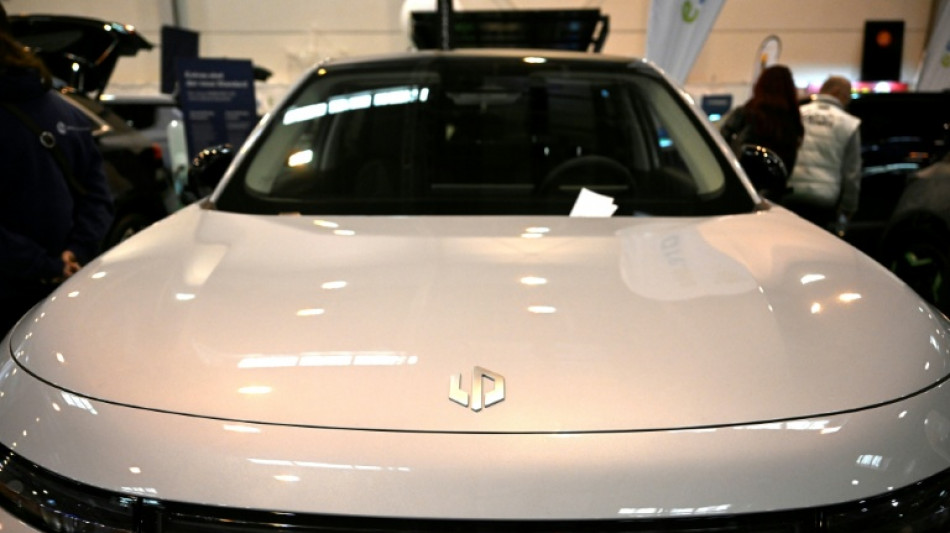
Selling factories to Chinese partners: risky road for European carmakers / Photo: Ina FASSBENDER - AFP/File



Carmaker Stellantis announced Friday it is considering selling an underutilised factory in Spain to its Chinese joint venture Leapmotor, which could save jobs in the short term but risks further strengthening Chinese automakers.
This is a question all European carmakers are facing. The continent's car market has never fully recovered from the Covid pandemic downturn and their factories are operating on average at only half capacity.
They also face an onslaught from Chinese carmakers, whose rapidly advancing technical prowess and low production costs pose major risks to global rivals.
And as weak demand makes the domestic Chinese market fiercely competitive, Chinese automakers are increasingly looking to Europe as an El Dorado.
Brands such as BYD, MG, Chery, Geely, Leapmotor, Jaecoo, and Xpeng, were virtually unknown three years ago in Europe.
Now they already account for nine percent of European sales overall and 14 percent of electric vehicle sales, according to the consulting firm Dataforce.
Tariffs and consumer incentives for which only European-assembled cars are eligible have posed a hurdle for Chinese automakers to gain market share in Europe.
So, they are increasingly looking to hop over these obstacles by manufacturing in Europe, either by building factories or, even more simply, by buying them.
Chery kicked off the trend in 2023 by buying a former Nissan plant in Barcelona, Spain, where it now plans to produce 200,000 vehicles a year.
It said last month it would open a research and design centre in Paris to work on developing a small electric car to manufacture in Europe for the local market.
Nissan is reportedly considering selling its British plant in Sunderland -- its last in Europe -- to Chery or the Chinese company Dongfeng.
- Closer collaboration -
This Friday, the Franco-Italian-American manufacturer Stellantis -- whose brands include Peugeot, Fiat and Jeep -- became the first European automaker to take the plunge.It announced it was considering partially selling its Villaverde site in Madrid to Leapmotor, in which it holds a 51-percent stake.
It already plans to open its Zaragoza plant so that Leapmotor can soon produce a model there under its own brand.
An electric SUV sold under the Opel brand could also be produced in Zaragoza in collaboration with Leapmotor.
And this is only the beginning: this German-Chinese car will serve as a template for other Stellantis vehicles.
Some European cars already incorporate a large number of Chinese components, such as Renault's electric Twingo, which was also designed at a Renault facility in China.
The Stellantis announcement, however, is the first time a European automaker has so openly presented such collaboration on producing models with a Chinese partner.
According to Bloomberg, Stellantis will not stop there.
It is reportedly considering selling three plants -- one each in France, German and Italy -- to another longstanding Chinese partner: Dongfeng.
A Dongfeng delegation recently visited the factory in France, a union representative confirmed to AFP.
Ford also confirmed on Thursday that it was in talks with Chinese company Geely over the partial sale of a plant in Valencia, Spain.
Geely, which is also a co-owner of Renault plants in Brazil and South Korea, would produce a model for the European market.
German giant Volkswagen is also tempted.
Its chief executive Oliver Blume said recently that the company was examining whether "there are opportunities for our Chinese cars in Europe or for opening this for partnering maybe with our partners we do have in China".
Other options included selling factories to defence manufacturers, he added.
"The worst one and most costly one is to close a plant," Blume said.
That view is shared by the chief executive of OPmobility, a French auto-parts manufacturer.
Selling European car factories to Chinese manufacturers would be "a smart option, rather than adding to overcapacity", said OPmobility chief executive Felicie Burelle.
- 'Siren song' -
But "we mustn't give in to this siren song," warned Bernard Jullien, an automotive industry specialist at the University of Bordeaux.
"For manufacturers, suppliers, employees and local officials, it is tempting to prefer selling to a Chinese player rather than disappearing," he noted.
"But this amounts to giving a leg up to a formidable competitor right here in the heart of Europe by providing a powerful accelerator for its penetration of our markets," Jullien wrote in an opinion piece on the website autoactu.com.
He sees such moves as taking the easy way out for a manufacturer like Stellantis, which has been losing ground in Europe.
With Chinese companies having taken the lead in developing electric vehicles, he did not exclude the company deciding to outsource electrification to its Chinese partners.
But this "every-man-for-himself" strategy will end up giving Chinese manufacturers a boost while "ruining European car manufacturing", Jullien warned.
Only lawmakers can act to prevent European carmakers from succumbing to this temptation, he added.
A.Andersson--StDgbl