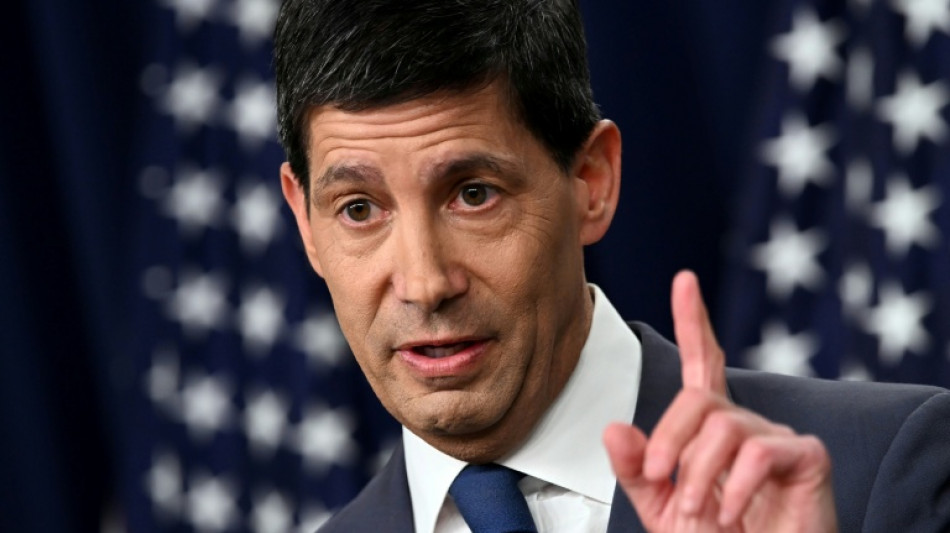
US Fed to deliver rate decision with markets betting on hike / Photo: Brendan SMIALOWSKI - AFP


The US Federal Reserve will announce its decision on setting interest rates for the world's largest economy on Wednesday, with markets betting the central bank will pull the trigger on a rate-hike to tackle surging inflation.
The Fed's Federal Open Market Committee, with its 12 voting members, will announce its decision after a two-day meeting on Wednesday at 2:00 pm (1800 GMT).
The world's largest economy has been dealing with years of higher-than-target inflation, and prices have surged in the wake of US President Donald Trump's war on Iran, his signature tariff policies and the ongoing AI boom.
The Fed has held rates steady since January, choosing to wait to gauge the effects of energy price shocks and to let the impact of tariffs on prices ripple through the economy.
At its last meeting in July, however, a quarter of voting members on the committee dissented from the decision to hold pat, calling for an immediate hike.
Since then, other policymakers -- including Fed Chair Kevin Warsh -- have hinted that if inflation does not meaningfully slow, the Fed may need to intervene.
On Friday, August's consumer inflation index came in at 3.4 percent -- unchanged from the month before, but still well above the Fed's long-term two-percent target.
The data fuelled market expectations of a rate hike at this week's meeting, with investors giving it a probability of more than 92 percent, as per CME's FedWatch tool.
"It is an about-face, but not a surprise. Inflation is still well above the two-percent target," said Diane Swonk, chief economist at KPMG.
"It has spread across the economy and is becoming embedded in consumer and firm behavior -- exactly what the Fed must prevent."
- Battling for credibility -
If policymakers vote to hike on Wednesday, it will be the first time the Fed has raised rates since 2023, when the central bank was still battling post-pandemic inflation.
Such a move will be sure to anger Trump, who has launched an unprecedented campaign to pressure the independent central bank to lower rates in order to spur economic activity.
The Trump administration launched a criminal probe against Warsh's predecessor Jerome Powell -- who the president regularly insulted and berated -- and is still trying to fire Fed Governor Lisa Cook.
On Tuesday, key Trump economic advisor Kevin Hassett advocated against a rate hike but said the White House would "understand and respect the decision" if that is what occurs.
Warsh was named to his position after a contentious Senate confirmation process, where Democratic lawmakers accused him of being a "sock puppet" for Trump, which he denied.
Now, analysts say, Warsh would prove his credibility by backing a rate hike that the US president is sure to oppose.
So far, Trump has supported Warsh despite not getting the rate cuts he has demanded, claiming that the Fed chair "wants" lower rates and accusing the board of being "political."
David Wessel, a senior fellow at Brookings, told AFP that if the Fed does deliver a rate cut, there is a chance that Trump intensifies those attacks.
"There's the risk that the administration will decide that Kevin's hand is being forced by some hawkish people on the committee, and so they'll redouble their efforts to get rid of some of them."
- 'Risks are real' -
Claudia Sahm, chief economist at investment firm New Century Advisors, said it was an "unfortunate" situation.
"You shouldn't have to prove yourself by inflicting Americans with higher mortgage rates. But it is kind of the reality of this situation," said Sahm, who previously worked at the Fed.
The Fed has a dual mandate to deliver maximum employment while keeping inflation to its long-term two-percent target.
It mainly achieves these goals by setting the key US interest rate -- lower rates tend to spur economic activity but fuel inflation, and hiking them cools both activity and prices.
"The risks of disproportionately hurting interest-rate-sensitive sectors or crystallizing a tightening in financial conditions amid a bond market selloff are real," said Gregory Daco, chief economist at EY-Parthenon.
"This is the debate policymakers will confront."
E.Blomberg--StDgbl