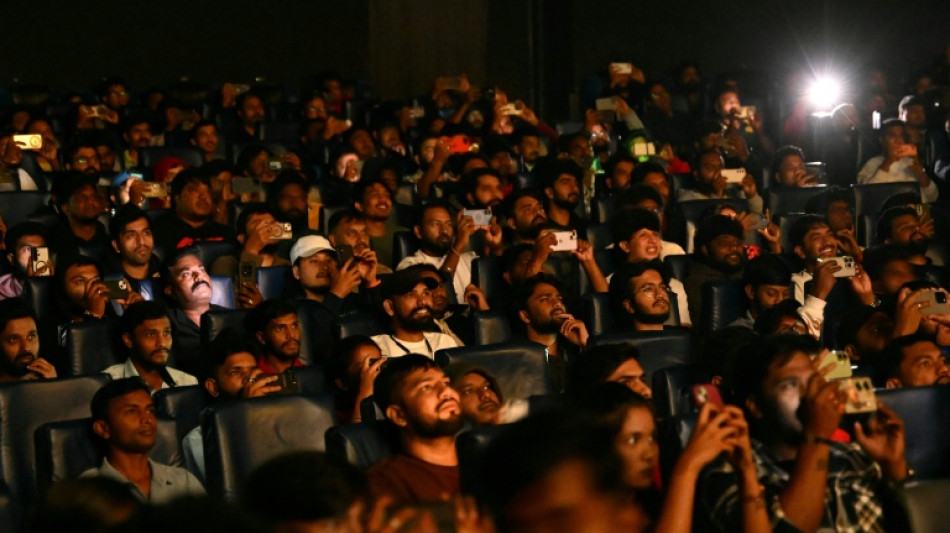
Curtain falls on the romance of India's single-screen cinemas / Photo: Idrees MOHAMMED - AFP



The demolition has begun at Bengaluru's Urvashi Cinema, once a 1,200-seat movie palace where generations of filmgoers cheered and whistled, another casualty of India's vanishing single-screen era.
"The theatre came up in the 1970s... I was so happy when it opened," said Manjunath, watching as seats were ripped out and strewn outside.
Manjunath, who uses one name, recalled its glory days, when the shop he runs opposite was packed with customers buying snacks before and after shows.
"That was the rush... now I have a lot of free time," he said. "But what to do? There is barely any crowd."
The peeling facades, faded signs and cavernous auditoriums of such cinemas are remnants of a time when going to the movies was itself the main event.
"It is a completely different experience," said photographer Hemant Chaturvedi, 58, who has documented what remains during a seven-year odyssey, photographing 1,350 single-screen cinemas across 1,000 towns.
His photographs capture not only the movie houses but their ornate facades and decay -- a record of a cultural landscape disappearing as cinemas are demolished, converted into multiplexes or left to crumble.
- 'Ecosystem is fading' -
"People would be cheering, jumping on the seats, even throwing money at the screen," Chaturvedi said.
The old halls offered a collective, interactive experience, with fans applauding at the hero's entrance, clapping to romantic songs and shouting at dramatic twists.
"Now that old ecosystem is fading, and the charm is being lost," he said.
India's single-screen cinemas have been steadily squeezed by multiplexes, streaming, rising property costs and the expense of maintaining ageing buildings and equipment.
Researchers estimate that India had around 14,000 single-screen halls in the 1980s. Only around 2,000 remain today.
Many of the old halls could accommodate around 1,000 people, creating a communal atmosphere rarely found in today's multiplexes.
The decline has also changed the way Indians experience films. New halls offer air conditioning, reclining seats and food delivered to the seat.
"To me, the new cinemas have lost the charm," said Chaturvedi, a former Bollywood cinematographer who worked on hit movies during a three-decade career.
"The multiplexes are a generic, cold experience."
- 'Old times' -
Some of the old cinemas have been restored and renovated, and the single-screen experience still has its devotees.
In Bengaluru, Mukunda Cinemas still draws crowds -- even for early-morning shows before work.
Hundreds lined up before dawn for a recent 6:00 am screening of the latest release of film star Yash, who is hugely popular in India's Kannada-language cinema.
Santosh, a 47-year-old businessman who uses one name, queued with hundreds of others as crowds set off fireworks outside while waiting for the show.
"Only in the single screen theatres can they take the cinema to the next level, it increases the tradition of cinema," Santosh said, as cheers and whistles reverberated through the packed hall before the film began.
Veerain Reddy, the third generation of his family running the 50-year-old theatre, said maintaining the establishment "was not an easy task".
Inflation, rising costs and "so much competition" have made business tough.
"But people who are really passionate are still trying to maintain these single-screen theatres, where people come to watch and celebrate cinema," he told AFP.
Another survivor in Mumbai -- formerly known as Bombay -- is the Regal Cinema, an Art Deco hall that opened in 1933.
"The rest of them feel very artificial, commercial, very blingy," said 23-year-old fan Vanshika. "But Bombay has little places which remind us of the old times."
J.Soderberg--StDgbl