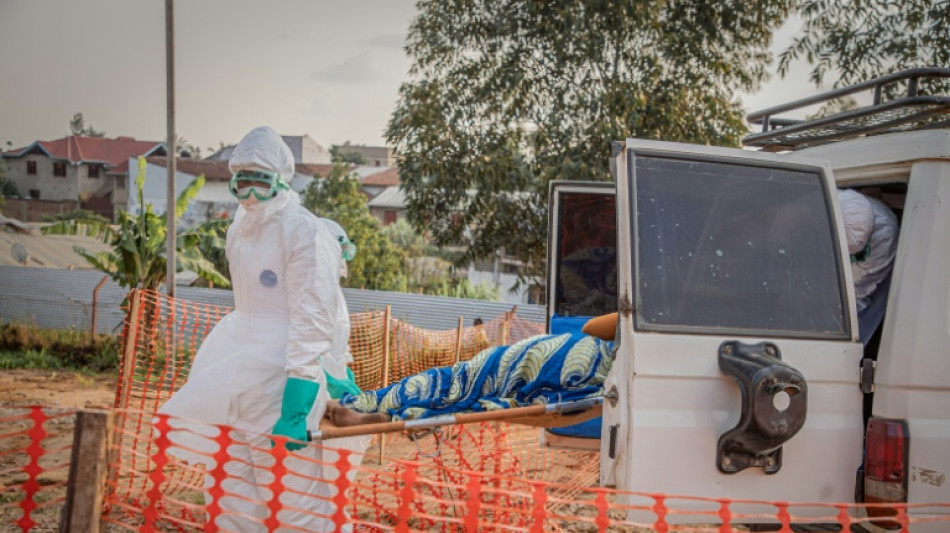
More than 400 dead in DR Congo's spreading Ebola outbreak / Photo: Benediction MURHABAZI - AFP/File


An Ebola outbreak in the DR Congo has killed more than 400 people and is still spreading, with a first case reported in the major city of Kisangani nearly 600 kilometres (370 miles) from its epicentre.
The highly infectious disease has claimed 438 lives among the 1,406 people confirmed infected -- a fatality rate of just over 31 percent -- since the outbreak was declared on May 15, the National Institute of Public Health (INSP) said in its latest report published on Thursday.
The centre of the outbreak -- whose true scale remains difficult to assess -- was in the northeastern Ituri province, where more than 83 percent of the deaths have occurred.
The province borders South Sudan and Uganda, which has reported 20 cases including two deaths.
The virus has also spread to the nearby provinces of North Kivu and South Kivu.
A case has also recently been reported in Kisangani, a northeastern city of 1.5 million residents and the capital of Tshopo province.
A test on the body of a 24-year-old pregnant woman was positive for Ebola, the INSP said.
"The deceased's body was secretly transported by motorcycle to Kisangani" from the health zone of Nia Nia in Ituri, the health authorities said.
The body of a deceased Ebola victim remains highly infectious and in many cases the virus has been transmitted during burial rites.
South African President Cyril Ramaphosa and the head of the African Union's health agency, Africa CDC, Jean Kaseya, were visiting the capital, Kinshasa, on Thursday.
- 'On the run' -
In Haut-Uele province, which is next door to Ituri, a death and a case of infection were also reported at the start of the week.
Health authorities said the infected person was "on the run" from the Nia Nia health zone.
Nevertheless, health authorities continue to say that only three provinces in total are affected by the virus, as they say that the cases in Tshopo and Haut-Uele were "imported" from Ituri.
Several contact cases have however been identified in the two provinces.
Ebola, which spreads through contact with bodily fluids, has killed more than 15,000 people in Africa over the past 50 years.
The current Ebola crisis is the 17th to hit the Democratic Republic of Congo, whose most deadly outbreak killed nearly 2,300 people between 2018 and 2020.
The Bundibugyo strain of the Ebola virus is behind the current outbreak and no vaccine or specific treatment exists.
But a trial of potential Ebola treatments has begun, the World Health Organization said on Thursday.
- Health centre set on fire -
Health and aid workers battling the viral haemorrhagic fever in Ituri face deep mistrust among the local population.
Some locals deny the existence of the disease, while others accuse international organisations of trying to make a profit.
On Wednesday, an Ebola health centre managed by local health authorities was set on fire in the health zone of Nia Nia, local sources told AFP.
Seven suspected cases, who were in isolation at the centre, fled and have not been found so far, Joseph Pemanakue, the area's chief medical officer, said.
Two bodies of people who likely died of the virus were also at the centre.
Before their sanitary burial "a group of young people opposed it and tried to retrieve the bodies, believing that these people had not died of Ebola and considering that this disease is a 'business'", Pemanakue said.
The police intervened with warning shots, but the protesters set the place on fire.
A police officer died after being attacked by the protesters and two young people were seriously injured, according to Matadi Muyapandi, police administrator for the area.
The young people managed to retrieve the two bodies. "This is a major risk of spreading," the chief medical officer said.
Similar incidents have been reported since the start of the outbreak.
It adds to the challenges facing the health response, which has been stepped up but was initially slow to get off the ground.
Health facilities in Ituri still lack equipment and basic supplies such as protective kits and chlorine.
L.Sundstrom--StDgbl