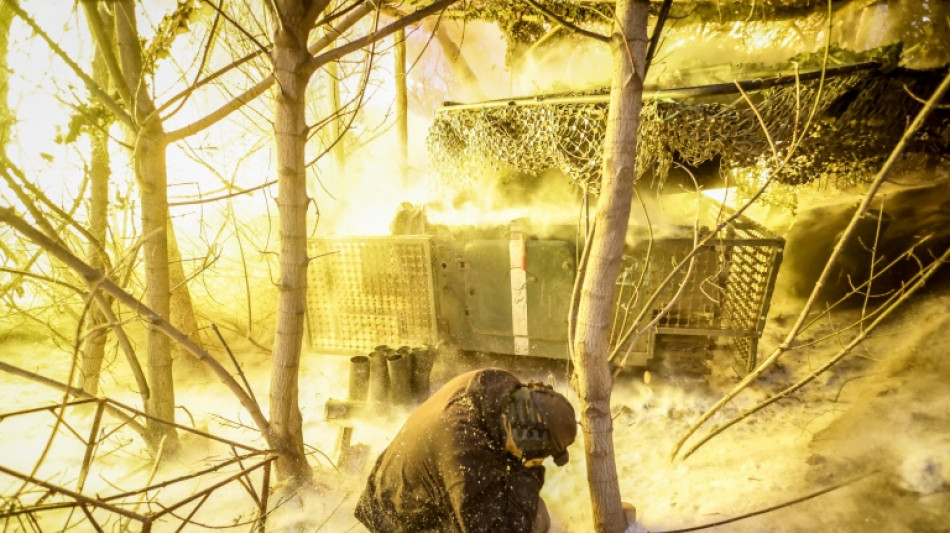
Almost half of Kyiv without heat, power, after Russian attack / Photo: OLEG PETRASIUK - 24th Mechanized Brigade of Ukrainian Armed Forces/AFP



An overnight Russian bombardment left thousands of residential buildings in Kyiv without heating and water in -14C temperatures on Tuesday, when the Ukrainian capital was already scrambling to restore vital utilities destroyed in earlier attacks.
The barrage of hundreds of drones and missiles, which targeted energy facilities across Ukraine, killed at least one 50-year-old man near Kyiv.
AFP journalists in the capital heard air raid sirens and explosions as Ukrainian air defence systems responded to the drones and missiles.
Sheltering in a metro station in the centre of Kyiv, Marina Sergienko, a 51-year-old accountant, said she thought the repeated Russian strikes, which have left millions in the cold and dark over recent weeks, had a clear purpose.
"To wear down the people, push things to some critical point so there's no strength left, to break our resistance," she told AFP, taking cover alongside dozens of other Kyiv residents bundled in hats and coats.
Foreign Minister Andriy Sybiga lashed out at Russian President Vladimir Putin, saying: "War criminal Putin continues to wage a genocidal war against women, children and elderly."
He said Russian forces had targeted energy infrastructure overnight in at least seven regions, and urged Ukraine's allies to bolster its air defence systems.
"Support for the Ukrainian people is urgent. There will be no peace in Europe without a lasting peace for Ukraine," he said on social media.
Zelensky suggested he would skip the ongoing World Economic Forum in Switzerland to deal with the aftermath of the strike.
But he kept open the possibility of going to the gathering of world leaders in the Swiss resort of Davos if agreements with the United States on possible post-war economic and security support were ready to be signed.
- Nationwide bombardment -
Russia fired some 339 long-range combat drones and 34 missiles in the overnight barrage, Kyiv's air force said.
Zelensky, who had recently complained of slow arms deliveries, said Ukraine had received a shipment of ammunition for air defences systems just one day before the attack.
The bombardment came around 10 days after the most significant Russian strike on Kyiv's energy grid since its invasion almost four years ago.
That strike, at dawn on January 9, left half the capital without heating and many residents without electricity for days in sub-zero temperatures.
Most of the buildings cut off on Tuesday were those affected on January 9.
Schools have been closed until February and street lights dimmed in a bid to preserve energy resources.
"After this attack, 5,635 residential buildings are without heating," Mayor Vitali Klitschko said on Telegram -- about half the capital's apartment blocks.
Much of Kyiv was also without running water, he added.
"Almost half of Kyiv is in blackout right now," Deputy Foreign Minister Mariana Betsa confirmed.
- 'Critical infrastructure' -
Authorities in the western region of Rivne said a separate attack there had damaged "critical infrastructure", leaving 10,000 households without power.
The head of the southern Odesa region added that Russian drone had crashed into a residential building and energy facilities had been hit.
And in the eastern Poltava region, local authorities said an attack had sparked fire at an industrial facility.
Russia has been pounding Ukraine's energy system since the start of its invasion, in what Kyiv says is an attempt to sap morale and weaken Ukrainians' resistance.
The Kremlin says it only targets Ukrainian military facilities and has blamed the continuation of the war on Kyiv for refusing to accept its peace demands.
The International Criminal Court has issued arrest warrants for two top Russian military officials over the attacks on Ukraine's energy grid.
The court said it constituted a war crime as it was designed to harm Ukrainian civilians.
Due to war-time sensitivities, Kyiv does not say which energy facilities have been damaged or destroyed in Russian attacks.
I.Pettersson--StDgbl