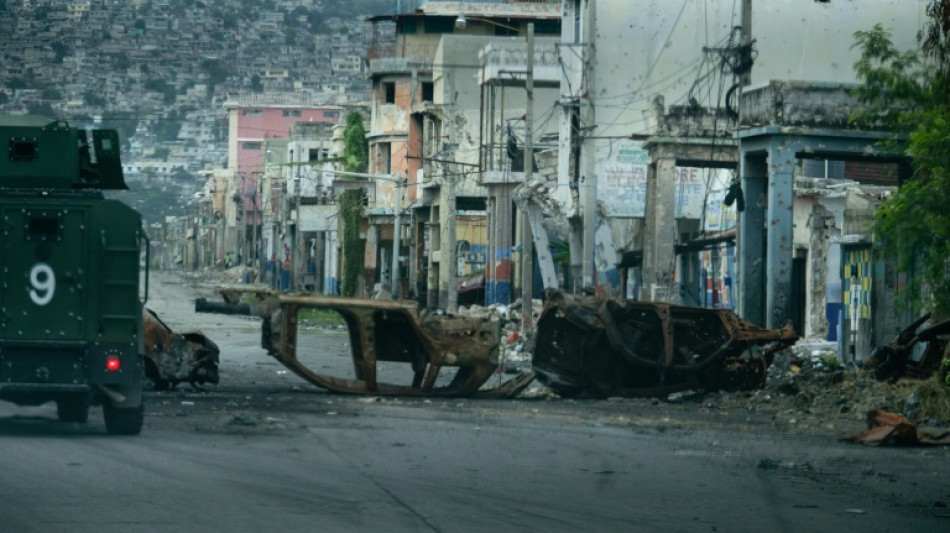
Violence-ridden Haiti in limbo as transitional council wraps up / Photo: Clarens SIFFROY - AFP


Nearly two years after it was created to restore order in impoverished, violence-ravaged Haiti, the transitional council is ending its work -- with no end to the crisis in sight.
"Once again, we have the impression of being back to square one," former Prime Minister Jean-Michel Lapin told AFP.
With the council's mandate expiring on Saturday, the current US-backed prime minister faces the monumental task of running parliamentary and presidential elections in August, the country's first elections in nearly a decade.
While he enjoys the support of Washington, premier Alix Fils-Aime faces deeply divided political elites, whose support he will need to hold the vote, and a traumatized population that has suffered from murders, rapes, looting, and kidnappings at the hands of gangs for years.
Currently, gangs control 90 percent of the capital Port-au-Prince, and they killed nearly 6,000 people and injured over 2,700 in 2025, according to the United Nations, with some 1.4 million, or 10 percent of the population, displaced by the violence.
And nearly half the population, or nearly 6 million people, face acute food insecurity, including 1.2 million children under the age of five.
- Fear of institutional vacuum -
Charged with bringing stability to the Caribbean nation, the nine-member Presidential Transitional Council (CPT) has achieved little, plagued by infighting, scandals and accusations of corruption. Several members have tried to push Fils-Aime out.
In an interview with AFP, Ted Saint Dic, a member of the Montana Accord movement, a civil society group, described the body as a "complete failure."
Its members "have plunged the country further into crisis," he said.
"The current members of the CPT have clumsily attempted to remain in power beyond their mandate," former lawmaker Antoine Rodon Bien-Aime told AFP.
Meanwhile, Lapin, the former prime minister, has denounced the council members for being "incapable of freeing themselves from their personal interests."
Fearing an institutional vacuum, Washington threw its support behind Fils-Aime, with US Secretary of State Marco Rubio emphasizing "the importance of his continued tenure as Haiti's Prime Minister to combat terrorist gangs and stabilize the island."
It also sanctioned two members of the CPT and a minister, accusing them of supporting gangs, and this week sent three warships to Haiti.
The European Union and Canada have also warned against any political change at the helm of the country.
Meanwhile, over the past several weeks, Haitian police have been conducting a large-scale offensive against gangs in central Port-au-Prince that saw the destruction of the house of one of the most notorious gang leaders, Jimmy Cherizier, also known as "Barbecue."
The effort is supported by a UN anti-gang force and a private security company.
In a rare piece of good news for the country, the Haitian national football team has qualified for the 2026 World Cup this summer, the first time since 1974.
Z.Nyberg--StDgbl