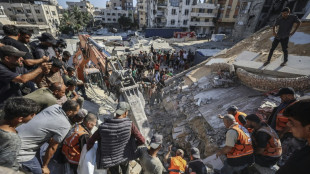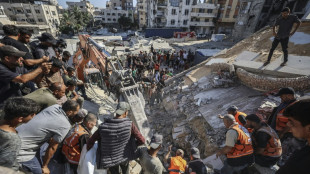
Iran vows to fight 'as long as needed' as Trump says war will end 'soon' / Photo: IBRAHIM AMRO - AFP


Iran's Foreign Minister Abbas Araghchi said Tuesday his country would keep fighting as long as necessary, casting doubt on US President Donald Trump's insistence that the conflict would be over "soon."
The remarks from one of Iran's top leaders, who also ruled out negotiations with Washington, came as Tehran launched a new wave of attacks on US-allied Gulf nations hours after Trump's assurances of a swift end to the rapidly widening conflict.
Trump's comments helped reverse the stock market slumps and oil price jumps of a day earlier, with markets in Tokyo and Seoul opening strongly, and oil prices down as much as five percent, a day after benchmark crude rocketed past $100 a barrel.
"It's going to be ended soon, and if it starts up again they'll be hit even harder," Trump told a news conference in Florida on Monday, after telling lawmakers that the campaign would be a "short-term excursion."
"We've already won in many ways, but we haven't won enough," Trump said.
He threatened an attack of "incalculable" size if Tehran blocks oil supplies.
"We will hit them so hard that it will not be possible for them or anybody else helping them to ever recover that section of the world, if they do anything."
However, in an interview Araghchi told PBS News "the firings continues, and we are prepared. We are well prepared to continue attacking them with our missiles as long as needed and as long as it takes."
Iran's Revolutionary Guards also responded to Trump that they would "determine the end of the war".
And Araghchi effectively ruled out negotiations with Washington, saying Tehran had "a very bitter experience of talking with Americans."
Recalling previous US attacks during earlier negotiations, he said: "I don't think talking with Americans anymore would be on our agenda."
- Some oil sanctions waived -
Early Tuesday, Iranian attacks again targeted Gulf nations.
The United Arab Emirates said it was "currently responding to incoming missile and drone threats from Iran," while in Bahrain citizens were told to take shelter as sirens sounded.
Both Saudi Arabia and Kuwait also said they had intercepted and destroyed drones.
In Iran, local media reported fresh attacks in the capital and Khomein, and Israel said it had struck an Iranian missile launcher shortly after an Iranian barrage that triggered warnings in several parts of Israel.
The ongoing fire laid bare the uncertainty that has roiled markets globally, prompting fuel shortages and raising the spectre of inflation.
In a bid to calm prices, Trump announced he would waive some sanctions on oil, following talks with Russian President Vladimir Putin.
Iran has targeted vessels traveling through the Strait of Hormuz, through which nearly 20 percent of the world's crude oil usually transits.
French President Emmanuel Macron said Monday his country and its allies were working on a "purely defensive" mission to reopen the strait, aiming to escort ships "after the end of the hottest phase of the conflict".
But it was far from clear when that might come.
Iran's new supreme leader is hardliner Mojtaba Khamenei, who replaces his father who was killed in the first day of US-Israeli strikes. Trump has called Khamenei a "lightweight" and said he should be involved in choosing Iran's leader.
The appointment was welcomed by some in Iran however, with state media carrying images of tens of thousands of people celebrating in central Tehran on Monday, many carrying the new leader's picture.
- 'Just a bit of bread' -
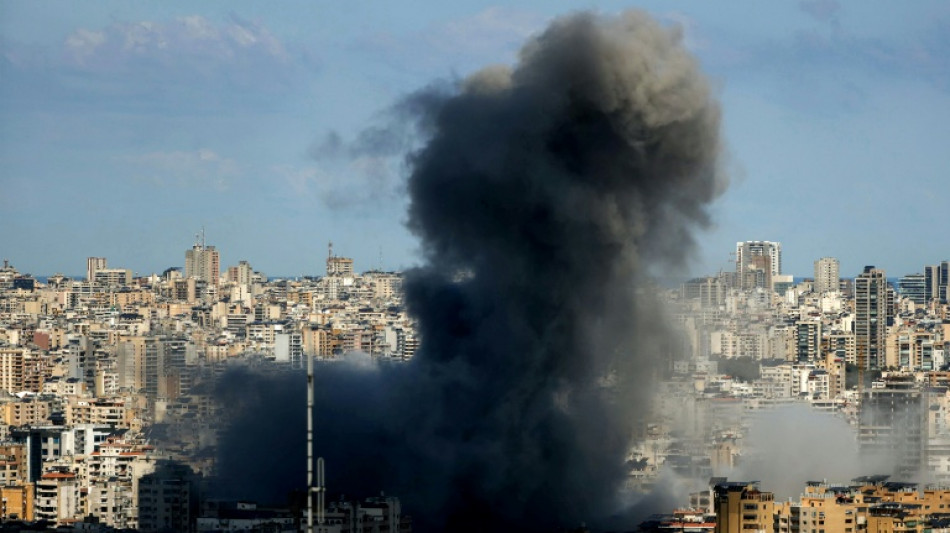
The war has spiralled far beyond Iran's borders, dragging in not only its Gulf neighbours but also Lebanon, where Israel carried out fresh strikes on Tuesday.
Lebanese authorities said Monday that Israeli attacks since March 2 have killed at least 486 people and wounded at least 1,313.
AFP has not been able to carry out a detailed breakdown of the figures.
Lebanon was drawn into the Middle East war when Iran-backed Hezbollah attacked Israel after the killing of Iranian supreme leader Ayatollah Ali Khamenei.
Lebanese President Joseph Aoun has accused Hezbollah of working to "collapse" the state, while the head of the group's parliamentary bloc said it had "no other option... than the option of resistance."
Syria too criticised the group, saying it had fired artillery shells into its territory from Lebanon overnight, and warning its army "will not tolerate any aggression."
Israeli strikes and ground incursions have pushed hundreds of thousands of Lebanese from their homes, with more than 660,000 registered as displaced, according to government figures.
Among them is Zainab El Masry, 40, who was sleeping with her husband and children on the grimy pavement of a Beirut square.
"We have nothing to eat or drink, just a bit of bread," she told AFP.
The conflict comes as Muslims mark the fasting month of Ramadan, and in Iran residents said they were grappling with the war and its impact on prices.
"What amazes me the most is that people insist on sitting out on the terrace to watch the bombardments, as if it were a show," said cafe manager Reza, 36, in the northeastern city of Boukan.
"The real problem is money: banks no longer distribute cash and many bank cards are blocked," he said.
"So in my cafe, I made a simple decision: for those who can't pay for their coffee, it's on the house."
burs-sah/hmn
T.Sjoberg--StDgbl