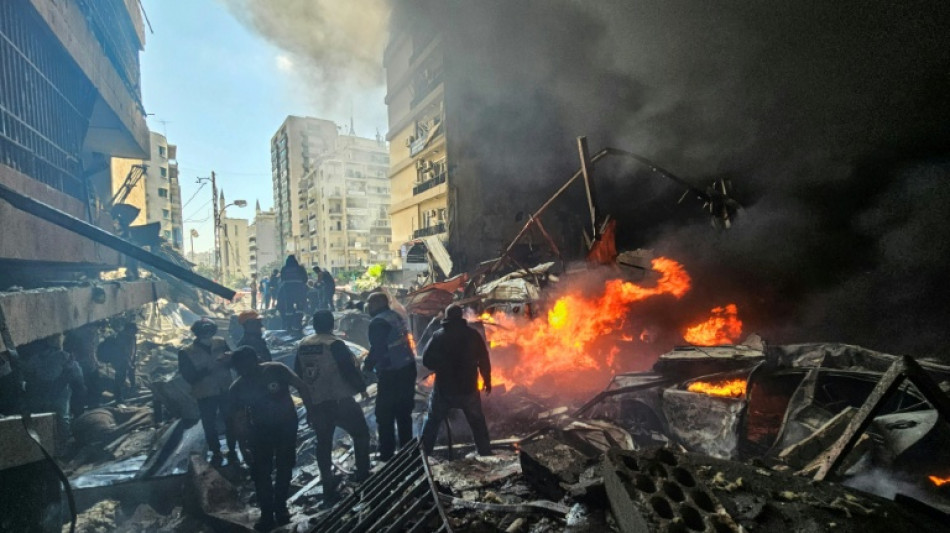
In the heart of Beirut, buildings in flames and charred cars / Photo: - - AFP
Buildings in flames, charred cars, ambulance sirens wailing: in an instant, an Israeli strike turned one of Beirut's busiest arteries into a scene of devastation on Wednesday.
Around 2:00 pm local time, a series of Israeli strikes slammed into the Lebanese capital without warning, triggering scenes of panic.
"People started running left and right, and smoke was billowing," said Ali Younes, who was waiting for his wife near Corniche al-Mazraa, one of the areas targeted.
The Israeli strikes on Lebanon, the heaviest since the war began in early March, left "dozens dead and hundreds wounded", according to a preliminary toll from the health ministry.
An AFP journalist saw thick black smoke rise from a building completely blown apart, amid the stench of gunpowder, at the Corniche al-Mazraa site.
Firefighters were trying to extinguish the blazes in the still-smoldering rubble, while rescue workers laboured to pull victims from the debris and bulldozers tried to clear a path.
"We were at work, we had about eight customers and we heard four blasts one after another," Hassan al-Sayed, the owner of a hair salon across the street, told AFP.
"The front of my shop was shattered," he added, standing on a sidewalk covered in broken glass.
– Overwhelmed hospitals –
The health ministry called on residents to urgently clear the roads for ambulances.
"The traffic jams caused by the unprecedented wave of strikes, in both number and intensity, carried out by Israel are hampering rescue operations," it said.
The simultaneous strikes hit several districts of Beirut at rush hour, triggering scenes of panic, according to AFP journalists.
Pedestrians began to run as drivers honked their horns, trying to force a way through.
A woman burst into tears in the middle of the street.
One of the strikes targeted Basta, a working-class neighborhood in the heart of the capital.
"I saw the blast, it was very strong and there were children killed, some with their hands blown off," Yasser Abdallah, who works in an appliance store nearby, told AFP.
Strikes also hit Beirut's southern suburbs, a stronghold for the Iran-backed armed group Hezbollah, after a warning from the Israeli army, as well as several areas in southern and eastern Lebanon.
Outside the American University of Beirut Medical Center, one of the capital's main hospitals, an AFP journalist saw a stream of ambulances.
Relatives of the wounded gathered at the entrance to the emergency department, where a woman wept, leaning on a young man.
"My mother-in-law is dead, my brother-in-law's wife too, and their son," said a man who did not want to give his name, adding that they all lived in the same building.
"We're waiting to find out if my brother-in-law's children are alive," he said.
A medical source who did not wish to be identified told AFP that the hospital was overwhelmed.
The hospital announced on social media that it needed blood of all types. A doctor told AFP he had donated blood himself.
The Israeli army said on Wednesday it had carried out its "largest coordinated strike across Lebanon" since the start of the war on March 2, shortly after the announcement of a truce with Iran.
Israel says the Iranian-American truce announced overnight does not include Lebanon.
"This morning they announced that Lebanon isn't included in the ceasefire deal whatsoever," said 20-year-old Kinda Assad, as she stood watching the smoke rise from a Basta building some 200 metres (650 feet) away.
"They already strike wherever they want and then make the excuse it was a targeted strike" against Hezbollah, she added.
B.Johansson--StDgbl