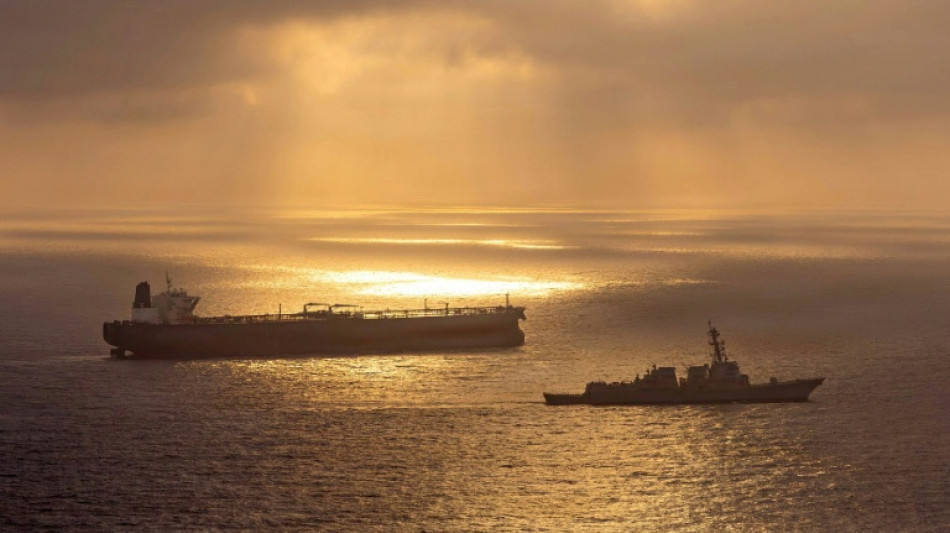
Gulf clash threatens hopes for quick US-Iran deal / Photo: - - US NAVY/AFP


A new clash between US and Iranian forces in the Gulf dented optimism for a negotiated peace Friday, despite President Donald Trump insisting a shaky truce was still holding while the sides inch towards a deal.
US Central Command said Iranian forces had launched missiles, drones and small boats at three US warships overnight but that none were hit, while American forces destroyed the incoming threat and retaliated against land bases in Iran.
Iran's own central military command, Khatam al-Anbiya, countered that the clash had erupted when US vessels targeted an Iranian civilian tanker heading towards the Strait of Hormuz, and accused its foe of hitting civilian areas.
These strikes hit Bandar Khamir, Sirik -- cities on the Iranian side of the Strait -- as well as Qeshm island, it said, alleging that the attack was carried out with the cooperation of "some regional countries".
Asked in Washington on Thursday if the ceasefire with Iran was still in effect after the clash, Trump said: "Yeah, it is. They trifled with us today. We blew them away. They trifled. I call that a trifle."
Iran did not identify the accused US allies by name, but the clash came as the United Arab Emirates complained that it had been forced to intercept a wave of drones and missiles from Iran.
Following the start of the war with US-Israeli attacks on February 28, Iran largely closed the Strait of Hormuz and the US later imposed its own blockade of Iranian ports.
Around 1,500 ships and 20,000 international crew are now trapped in the Gulf region because of the conflict, according to the UN International Maritime Organization.
- 'Knock them out' -
Tehran had denied carrying out a strike on Monday on the major UAE oil terminal in Fujairah, but Iranian analysts have been allowed to appear on state media to suggest the Emiratis have been involved in recent attacks on Iran.
World markets had perked up and oil prices fell this week amid hope that a Pakistani-mediated peace process will prolong the US-Iran ceasefire that began on April 8 and lead to a negotiated accord to end the conflict.
But stock markets sank again on Friday after the exchange of fire in Hormuz, which fuelled fears renewed fighting could delay or derail the re-opening of the key maritime trade route, despite Trump dismissing the incident as an irrelevance.
This week Trump has fed hopes of a deal, saying an agreement could be near even as he again threatened to return to bombing if Tehran refused to back down.
But he doubled down on that stance after Thursday's clash, posting on his Truth Social platform: "We'll knock them out a lot harder, and a lot more violently, in the future, if they don't get their Deal signed, FAST!"
Iran's foreign ministry spokesman Esmaeil Baqaei had said Thursday that Tehran would communicate its position to mediator Pakistan "after finalising its views."
Pakistani Prime Minister Shehbaz Sharif struck an optimistic tone prior to the exchanges of fire on Thursday, saying in televised remarks: "I firmly believe that this ceasefire will turn into a long-term ceasefire."
- Lebanon talks -
Any agreement between Washington and Tehran could also help lower tensions in Lebanon, where a separate truce was under renewed strain after an Israeli strike on southern Beirut killed a Hezbollah commander on Wednesday.
A US State Department official confirmed on Thursday that the new Israel-Lebanon talks would take place on May 14 and 15.
It will be the third meeting in recent months between the two countries, which have technically been at war for decades and have no diplomatic relations.
US Secretary of State Marco Rubio said Tuesday that a peace deal between the two sides was "eminently achievable", insisting that Hezbollah was the sticking point, rather than any issue between the two governments.
Both Israel and Iran-backed Hezbollah have kept up their attacks despite the ceasefire.
Lebanon was drawn into the Middle East war when Hezbollah fired rockets at Israel in retaliation for the killing of Iranian supreme leader Ayatollah Ali Khamenei at the outbreak of the broader war.
burs-dc/jfx
K.Bergqvist--StDgbl