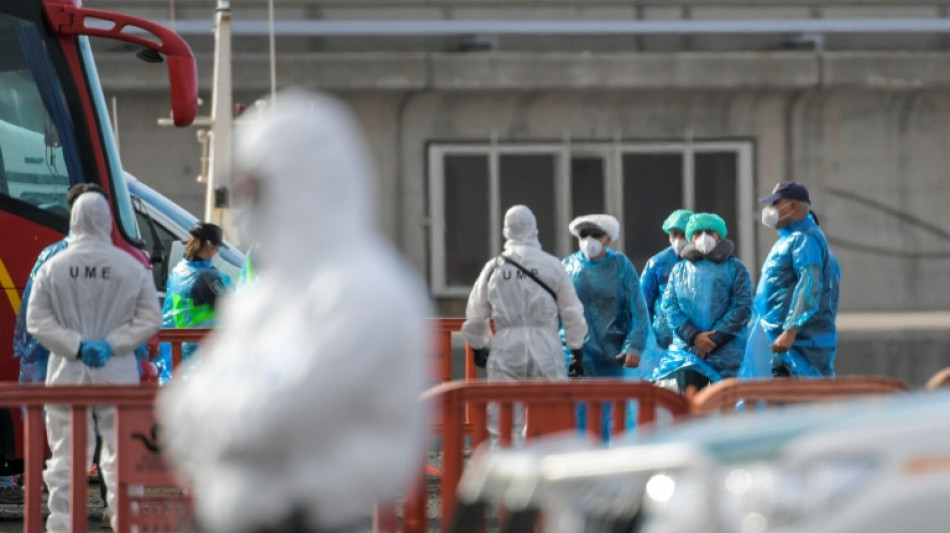
US, French nationals from hantavirus ship test positive / Photo: JORGE GUERRERO - AFP



An American national and a French woman evacuated from the cruise ship hit by a deadly hantavirus outbreak have tested positive, officials said Monday, as the complex operation to repatriate those on board continued.
The French woman, one of five passengers from France flown back from the MV Hondius and placed in isolation in Paris, started to feel unwell on Sunday night, and "tests came back positive", said Health Minister Stephanie Rist.
Late Sunday, the US health department said one American national evacuated from the ship had "mild symptoms" and that another had tested positive for the Andes virus, the only hantavirus strain that is transmissible between humans.
Three passengers from the ship, a Dutch couple and a German woman, have died, while others have fallen sick with the rare disease, which usually spreads among rodents.
No vaccines or specific treatments exist for hantavirus, which is endemic in Argentina, where the ship set sail in April.
But health officials have insisted that the risk for global public health is low and downplayed comparisons to the Covid-19 pandemic.
Rist said 22 more contact cases had been identified among French nationals, including eight people who had travelled on an April 25 flight between Saint Helena and Johannesburg, and 14 more on a flight between Johannesburg and Amsterdam.
The Dutch woman who died was on the flight to Johannesburg and later briefly boarded a flight to Amsterdam but was removed prior to takeoff.
Health authorities in several countries have been tracking passengers who had already disembarked from the ship, plus anyone who may have come into contact with them.
The repatriation operation evacuated 94 people of 19 different nationalities on Sunday, Spanish Health Minister Monica Garcia announced on Tenerife, in Spain's Canary Islands.
Spanish officials said the evacuation of most of the ship's nearly 150 passengers and crew, which includes 23 nationalities, would continue until the final repatriation flights to Australia and the Netherlands on Monday afternoon.
The Dutch-flagged ship will refuel in the morning and is expected to depart for the Netherlands with about 30 crew members at 7:00 pm (1800 GMT) on Monday.
Passengers in blue medical suits began disembarking the vessel on Sunday to reach the small industrial port of Granadilla on Tenerife, AFP journalists saw.
- Race against time -
Canary Islands authorities have warned that the operation must be completed by Monday, when adverse weather conditions will force the ship to leave.
The Atlantic archipelago's regional government has consistently resisted taking in the ship, which was only authorised to anchor offshore.
The World Health Organization recommends a 42-day quarantine and "active follow-up", including daily checks for symptoms such as fever, the UN body's epidemic and pandemic preparedness and prevention director, Maria Van Kerkhove, said in Geneva.
Greece's health ministry said a Greek male evacuee would spend 45 days in mandatory hospital quarantine in Athens, while 14 Spanish citizens will also isolate at a military hospital in Madrid.
Australia said it would place its six evacuees in a purpose-built quarantine facility north of Perth for at least three weeks.
British officials said 20 UK citizens who were aboard the ship would be taken to a hospital near Liverpool for tests and about 72 hours of quarantine.
Depending on the estimated risk, passengers can choose to go home "without exposing other people on the way", said Jay Bhattacharya, acting director of the Centers for Disease Control and Prevention.
WHO chief Tedros Adhanom Ghebreyesus, who was on Tenerife to help supervise the evacuations, said that policy "may have risks".
The group was expected to land in Omaha early Monday morning, said a spokesperson for the University of Nebraska Medical Center.
- International concern -
The Hondius left Ushuaia, Argentina on April 1 for a cruise across the Atlantic Ocean to Cape Verde.
The WHO believes the first infection occurred before the start of the expedition, followed by transmission between humans on board the vessel.
But Argentine health officials have questioned whether the outbreak originated in Ushuaia, based on the virus's weeks-long incubation period and other factors.
burs-al/imm/db/lga/jhb/rlp
P.Jakobsson--StDgbl