WHO chief visits epicentre of Ebola outbreak in DR Congo / Photo: Glody MURHABAZI - AFP


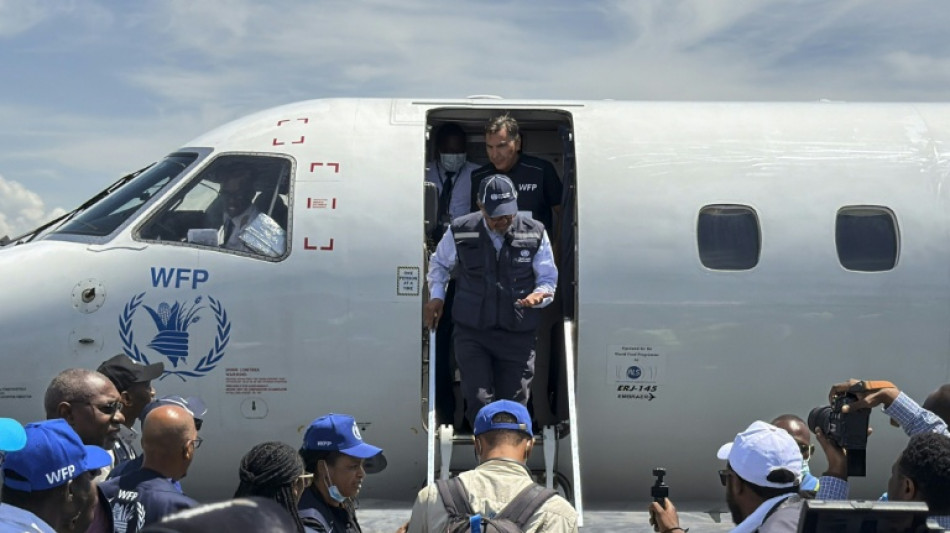
UN health chief Tedros Adhanom Ghebreyesus landed on Saturday in the eastern Democratic Republic of Congo province worst-hit by a severe Ebola outbreak, an AFP journalist saw.
The World Health Organization's director general told reporters in Bunia, capital of Ituri province, that the international community was helping the DRC government cope with the outbreak, but "at the same time community ownership is important".
He said that was the reason for his trip: "We are here to discuss with the community, to see how the response is running and if there are challenges to help."
The highly contagious haemorrhagic fever is already present in three eastern DRC provinces and in neighbouring Uganda, where nine confirmed infections, including one death, have been recorded.
There have been at least 1,077 suspected cases of Ebola in the DRC since the outbreak was declared on May 15, including 246 deaths, the Africa Centres for Disease Control and Prevention said on Thursday.
The true reach of the outbreak in the DRC, which is thought to have been circulating before it was detected, is likely to be much wider, the WHO has warned.
The vast, unstable central African country -- whose impoverished east has been plagued by three decades of conflict -- has limited capacity to conduct laboratory tests to confirm cases.
- Conflict and Ebola -
Uganda closed its border with the DRC this week and ordered a 21-day quarantine for anyone arriving from that country.
On Friday, the WHO announced that a patient had recovered on Wednesday, left hospital and was discharged into the community after two negative tests.
WHO's Anais Legand told reporters in Geneva it marked the "first" among patients who had been confirmed Ebola carriers in the current outbreak.
Ebola, which is passed on through close contact and bodily fluids, has killed more than 15,000 people in Africa over the past 50 years.
The deadliest outbreak in the DRC claimed nearly 2,300 lives out of 3,500 cases between 2018 and 2020.
The medical charity Doctors Without Borders (MSF) said in a statement of the latest outbreak that "never has an Ebola epidemic recorded so many cases in the first days after it being declared".
It said the numbers of medical experts being deployed to the region was still insufficient.
State services are largely lacking in Ituri province, where access is hindered by insecurity due to the presence of Islamic State-affiliated ADF militants and other militias that regularly kill civilians.
The nearby North and South Kivu provinces, that have also seen Ebola cases in the outbreak, have been plagued by near continuous violence for three decades.
Swathes of the regions are controlled by the Rwanda-backed armed group M23 which has been battling government forces.
Millions of people have fled the fighting and are living in displacement camps with poor hygiene conditions.
Nearly a million of those displaced are in Ituri province, where the prospect of the epidemic spreading throughout the camps has sparked alarm.
"If Ebola comes, we'll be wiped out as we're packed like sardines," Dorcas Mapenzi said at the Kingonze camp on the outskirts of Bunia.
No vaccine or specific treatment exists for the Bundibugyo strain of Ebola, which is behind the current outbreak.
But the head of the CDC Africa said on Thursday that a vaccine should be ready by the end of the year.
J.Soderberg--StDgbl