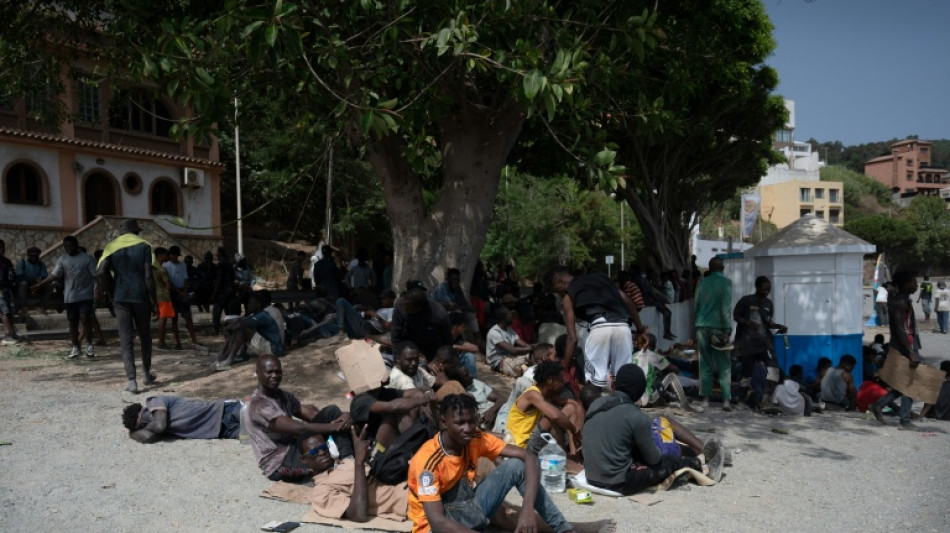
In Spain's Ceuta, exhausted migrants end short trip with little hope / Photo: JORGE GUERRERO - AFP



Migrants streamed back across the border into Morocco in small groups after spending two or three days in the Spanish enclave of Ceuta, wandering the streets with almost nothing to eat, and little welcome.
On Saturday morning, Spanish soldiers and Civil Guard officers directed a steady flow of people -- mostly very young men -- toward the exit at the border crossing.
Some were barefoot, others had Red Cross blankets draped over their shoulders. Many were visibly exhausted after days of wandering around the town.
"I'm leaving because there's no food. I thought I'd be welcomed, but that wasn't the case at all," said 23-year-old Abdel Latif before crossing back over the border.
He had tried his luck to "find work\" because "there are no jobs in Morocco," lamented the young man. He survives by doing odd jobs as a mechanic.
Latif was one of as many as 60,000 migrants who crossed into Ceuta, mostly swimming around the small border post that juts into the Mediterranean Sea, in an unprecedented surge that prompted an international crisis for Spain and questions about immigration.
A few intrepid young men still attempted to reach the enclave by swimming on Saturday.
Two men collapsed on the sand in plain view of the soldiers, exhausted from their sea crossing. One of them, severely weakened, had to be attended to by Red Cross rescuers, wrapping him in blankets -- despite the heat -- before taking him away on a stretcher.
A soldier was ushering another man toward the exit, his still-soaked clothes bore witness to his recent arrival.
Further along, another man attempting to swim across was picked up by a Spanish Civil Guard boat and then taken back toward Morocco.
– 'No future in Morocco' –
Around 60,000 migrants arrived over the course of two or three days, according to an estimate by the head of the local government, Juan Jesus Vivas.
The Spanish interior ministry, meanwhile, puts the figure at 50,000 people.
At least 67 of them died while attempting to swim to Ceuta, according to Interior Minister Fernando Grande-Marlaska, who lamented these "sad, dramatic events."
"Almost all" of those who entered the enclave in recent days have returned to Morocco, according to the Spanish government.
Ceuta -- a small territory of 84,000 inhabitants located at the northern tip of Morocco and bordering the Strait of Gibraltar -- forms one of the two land borders between Africa and Europe, along with Melilla.
"An invasion? No, that's a lie! People want to come because there is no future in Morocco," declared Soufiane, 42, who arrived by swimming on Thursday.
Back home, he works as a security guard "twelve hours a day for 10 euros," he explained to AFP, declining to give his surname.
Encountered by the seaside, he had a black eye and a cut on his left cheek -- the result of a fight between migrants during a food distribution, he said.
At the border, two boats were installing a floating barrier in the sea on Saturday morning to block access.
Inside Ceuta, most shops have reopened, cafes are full, and traffic is heavy once again after the town all but shut down during the surge.
In front of a downtown convenience store, a small crowd of Moroccans were waiting to enter, but the staff had closed the doors, asking them to form a queue.
Two police officers then chased them off, sending them running, under the watch of soldiers stationed nearby.
A few minutes later, the crowd returned and the queue immediately formed again.
- Relative normality –
The situation has "virtually" returned to normal, Spanish Interior Minister Fernando Grande-Marlaska announced.
Irene Benitez disagrees, seeing "nothing normal" or "calm" on the streets of her city.
"We're scared; we didn't need this," said the 40-year-old cook.
But Dris, 58, who did not disclose his surname, said "honestly, things are fine today... the police have arrived, and we can go out and shop", while carrying groceries outside a supermarket.
I.Westerberg--StDgbl