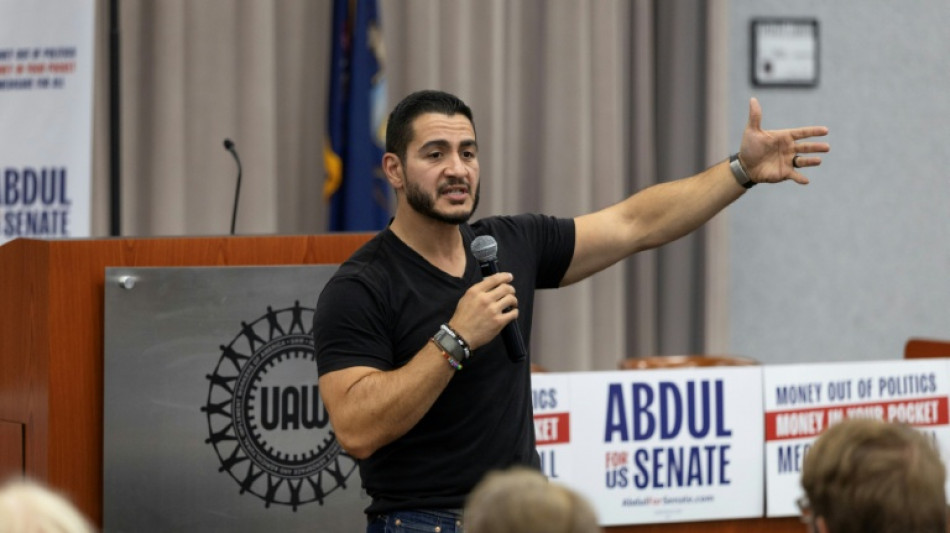
Leftist Democrat wins stunning primary victory in crucial Michigan / Photo: SCOTT OLSON - GETTY IMAGES NORTH AMERICA/AFP/File



A leftist insurgent Democrat defeated the party establishment's candidate to score a stunning win Wednesday in the primary race for the Senate after harnessing popular discontent and anti-Israel sentiment.
Abdul El-Sayed, a former public health official, narrowly beat veteran politician Haley Stevens after a bruising race seen as a window on the Democratic Party's internal struggle to define itself in the Donald Trump era.
El-Sayed will now run in November's midterm election for the US Senate against Republican Mike Rogers.
In a swing state that has twice narrowly backed Trump for president, that will be one of a handful of key battles deciding whether the Democrats can claw their way to controlling the Senate.
While Democrats are bullish that they can win the House of Representatives from Republicans in November, the Senate contest will be far harder.
To secure the Senate -- and thereby the ability to shut down much of Trump's agenda for the rest of his term -- Democrats must keep Michigan while flipping four Republican-held seats around the country.
Mainstream Democratic Party leaders had backed Stevens, thinking she was more likely to appeal to a broader group of voters and give them the best chance to hold the Senate seat, which is being vacated by a retiring Democrat.
But El-Sayed, a former Wayne County health director backed by leftist party leaders Bernie Sanders and Alexandria Ocasio-Cortez, electrified voters and overcame Stevens's vastly bigger campaign budget.
He has cast himself as a working-class fighter willing to confront corporations, party leaders and increasingly unpopular pro-Israel donors.
Stevens swiftly conceded to El-Sayed, saying she would "offer him my full support as we work to defeat Mike Rogers."
Trump quickly shot off his own message, branding El-Sayed "a Communist loser who hates Jews and Israel."
- Volunteer energy -
El-Sayed's allies say the campaign's volunteer energy proves progressives can build a statewide coalition without relying on Washington's traditional donor network.
The campaign also laid bare bitter divides over the United States' deep support for Israel.
Stevens defended continued military backing for the country and rejected accusations that Israel committed genocide in Gaza.
El-Sayed has called for an end to unconditional US aid, attacked the influence of the American Israel Public Affairs Committee (AIPAC) lobby group, and said Israel should not exist specifically as a Jewish state.
- Pro-Israel lobby's financial power -
AIPAC spending and outside advertising totaling $90 million -- in a state with a large Arab American population and deep anger over the Gaza war -- has made Michigan another national test of the pro-Israel lobby's ability to shape Democratic primaries.
The candidates traded increasingly personal attacks, with El-Sayed calling Stevens "the least capable candidate in America," while she has accused him of blaming his problems on Jewish Americans.
Congresswoman Debbie Dingell, who has remained neutral, warned that the "brutality" and "ugliness" of the campaign could make it harder for Democrats to unite afterwards.
Michigan voted narrowly for Trump in 2024, even as Democrat Elissa Slotkin edged Rogers in that year's Senate race, underscoring both the state's competitiveness and the risks of a divided party.
"The Democratic establishment threw everything it had at Abdul El-Sayed. If he wins, the reverberations will be felt far outside of Michigan," Dan Pfeiffer, a senior aide in Barack Obama's White House turned political analyst and podcast host, posted on X.
W.Axelsson--StDgbl