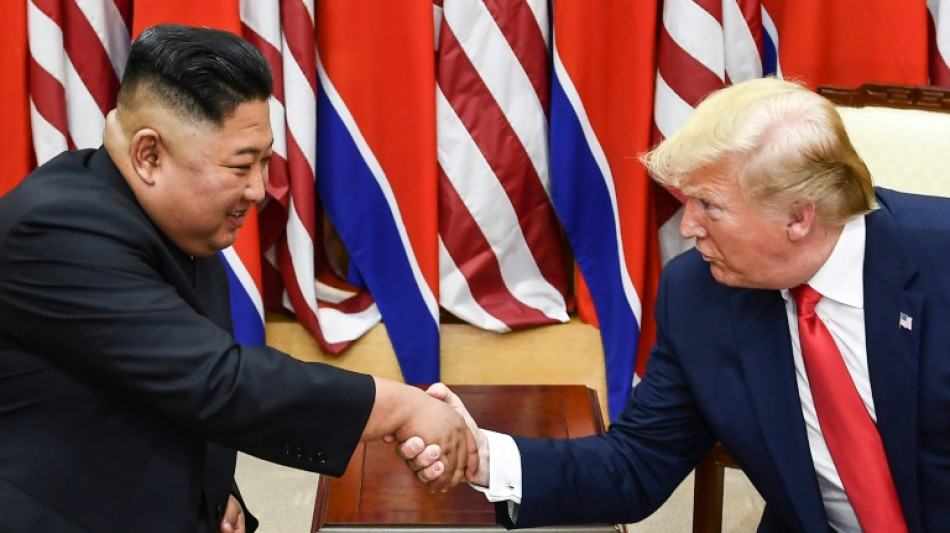
More Trump-Kim 'love'? What we know about North Korea / Photo: Brendan Smialowski - AFP/File



US President Donald Trump says Kim Jong Un had responded to his recent overtures and praised his relationship with the North Korean leader a day after scaling back military drills with South Korea.
Analysts say Kim now enjoys greater global stature, buoyed by crucial backing from Russia and China as well as an improving economy.
AFP looks at what we know about the nuclear-armed country's current state:
- Ties with Russia -
North Korea has been playing a more active role in international conflict, notably backing Russia in its invasion of Ukraine.
Pyongyang's participation in the war has brought the impoverished country economic and military benefits as well as valuable battlefield experience, analysts say.
Hong Min, a senior researcher at the Korea Institute for National Unification, said North Korea had gained "practical experience across virtually every aspect of modern warfare", including land, air and sea operations, as well as drones.
Last week, Colonel Ryan Donald, spokesman for the US-South Korean Combined Forces Command, said the allies would prepare troops for a potential fight against North Korean forces battle-hardened in Europe.
Showing his elevated status, Kim appeared alongside Chinese President Xi Jinping and Russia's Vladimir Putin at a military parade in Beijing last year.
- Once 'in love' -
Trump met Kim three times during his first term -- once declaring they were "in love" -- in high-profile summits aimed at securing a denuclearisation deal, but no tangible progress was made.
The US president even bucked decades of US policy by stating North Korea was "sort of a nuclear power" in October.
But Trump's comment at the time -- that he was "100 percent" open to meeting Kim again -- have gone unanswered.
Analysts say with Russia's critical backing, Kim now has fewer reasons to engage with Trump.
Kim "no longer needs the legitimacy of a handshake; he needs guaranteed, irreversible sanctions relief before he even walks into the room", Seong-Hyon Lee, a visiting scholar at the Harvard University Asia Center, told AFP.
- Missile tests and drills -
Pyongyang has also recently bristled at Japan's military build-up, firing ballistic missiles after Tokyo -- a key security ally of Washington and Seoul -- pledged to strengthen its defences with a "sense of urgency and crisis".
The North has long condemned annual US-South Korea joint exercises as rehearsals for invasion, often staging missile launches around the drills.
During his first term, Trump said after his initial meeting with Kim in Singapore in June 2018 that Washington would suspend the "provocative" drills.
The United States stations about 28,500 troops in South Korea to bolster the country's defences, a legacy of the 1950-53 Korean War that ended with an armistice rather than a peace treaty.
Apart from Seoul, other US partners across the region are under pressure to spend more on their militaries, including Taiwan, which Beijing claims is part of its territory and has threatened to use force to annex.
- Improved economy -
Largely thanks to its participation in Moscow's war against Ukraine, South Korea's central bank estimated last month that Pyongyang's economy grew more than three percent for a third straight year in 2025.
"The expansion of economic cooperation with Russia was a major driver of North Korea's growth last year," a BoK official told AFP.
More weapons exports to Russia boosted related manufacturing, while Russian tourists and expanded transport links lifted construction and services, she added.
China, Washington's chief geopolitical rival, has also been a major North Korean trading partner and a key source of diplomatic and economic support for the country, hit by multiple international sanctions.
Annual bilateral trade -- a significant component of which is wigs made in the North -- has reportedly recovered since the pandemic to almost $3 billion.
- Seoul the 'enemy' -
South Korea's dovish President Lee Jae Myung has pursued engagement with the North since taking office in June 2025, in contrast to his hardline predecessor Yoon Suk Yeol.
But Pyongyang has rejected his overtures, labelling Seoul its "most hostile" enemy and declaring itself an "irreversible" nuclear state.
Seoul has persisted, with its unification minister saying in July it had shifted from prioritising denuclearisation to halting the expansion of Pyongyang's nuclear activities.
Lee proposed talks at the weekend to formally end the Korean War and said Tuesday that joint US-South Korean drills showed no "intention to attack North Korea or escalate tensions on the Korean peninsula".
Park Won-gon, a professor at Ewha Womans University, said Seoul could still play "a constructive supporting role" if US-North Korea talks resume.
But, unlike Trump's first term when inter-Korean ties improved alongside US-North Korea dialogue, Pyongyang could now "bypass" Seoul, he added.
N.Jonsson--StDgbl