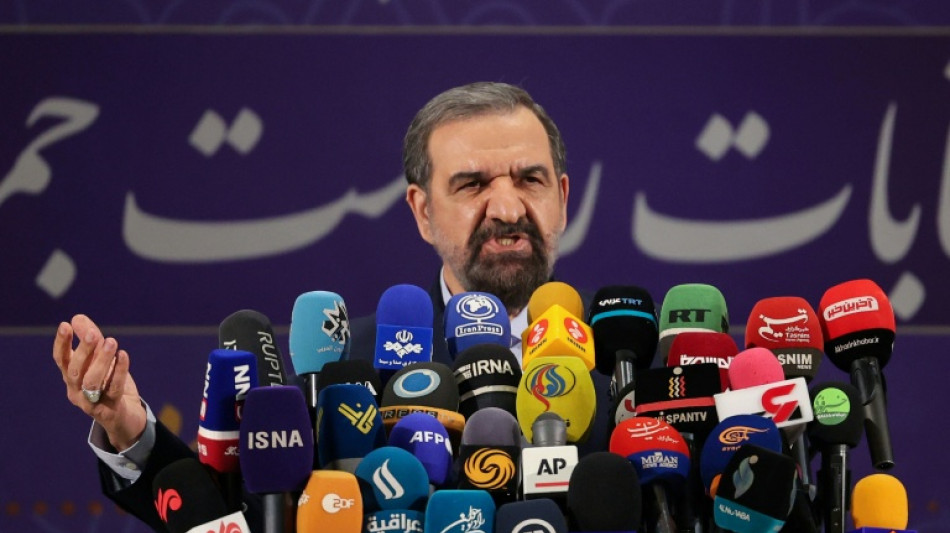
'More confrontational': Iran's new hardline security leadership / Photo: ATTA KENARE - AFP/File



Earlier this month Iranian supreme leader Mojtaba Khamenei reshuffled Tehran's top security team, putting his own personal stamp on the appointments and readying the Islamic republic for a long-term confrontation with the United States.
Khamenei, in power since his father Ali Khamenei was killed at the start of the US-Israeli war against Iran in February, has yet to be seen in public since taking on the top job and his health and influence remain uncertain.
But on August 9 and 10 he filled key security posts -- many of which became vacant after previous incumbents were killed in the war -- with loyal, veteran figures hailing from the Revolutionary Guards (IRGC), Iran's ideological army, which has a long history of antagonism with the US.
They included Mohsen Rezaei, 71, a former commander of the IRGC for almost all the 1980s war against Saddam Hussein's Iraq and Hossein Taeb, 63, a former Guards intelligence chief who stepped down in mysterious circumstances in 2022.
The appointments are "indicative of the adoption of a more risk-ready, confrontational stance", said Jason Brodsky, policy director of the US-based United Against Nuclear Iran (UANI) think tank.
"These appointments are demonstrative of Iran believing it will be in a wartime footing for the foreseeable future," he said, adding that Khamenei has brought back "the old guard" of the IRGC.
It remains to be seen where the appointments will leave diplomacy with the US, after the expiry of a 60-day deadline for an agreement. The talks have so far been led by parliament speaker Mohammad Bagher Ghalibaf who has become seen as a less hardline figure.
Here AFP looks at the key figures in Iran's security apparatus:
- Supreme national security council secretary Mohsen Rezaei
Commander of the Revolutionary Guards in the 1980s and 1990s, Rezaei has never been far from prominence, with his stern face and black beard a familiar presence for Iranians on TV.
His forays into mainstream politics have not been successful, with several failed presidential bids, and his sudden elevation to the key post once held by Ali Larijani, who was killed in the war, surprised some observers.
In April, he warned that Iran would sink American ships in the Strait of Hormuz if the United States decided to "police" the key shipping bottleneck and in June said every American attack would be met by a "deluge" of missiles.
A 2020 US sanctions designation said he is suspected of involvement in the 1994 attack against a Jewish community centre in Argentina.
- Basij commander Hossein Taeb
Taeb, a cleric, was named commander of the Basij, the IRGC's vast youth militia, which has become notorious as an enforcer of security in Iranian neighbourhoods.
He had led the intelligence arm of the IRGC for almost one-and-a-half decades up until June 2022 when he was suddenly replaced.
Why he was forced out was never made clear, although his departure coincided with the leaking of details over an alleged plot to target Israelis in Turkey.
Long seen as close to Mojtaba Khamenei, Taeb's appointment is seen as a sign of the authorities' readiness to suppress any repeat of the mass protests that erupted in January this year.
"Taeb's appointment also reflects the Iranian establishment's fear of renewed unrest as the economic situation deteriorates, with the Basij likely to play a leading role in quashing future protests," said Brodsky.
- Revolutionary Guards commander-in-chief Ahmad Vahidi -
A former interior and defence minister, Vahidi is the third commander-in-chief of Iran's ideological army in less than a year after his predecessor Mohammad Pakpour was killed on the first day of the war and Hossein Salami was killed during Israel's 12-day war against Iran in June 2025.
Possibly for this reason, Vahidi kept a very low profile in the war, making his first public appearance during the funerals of Ali Khamenei in July.
While several written statements had been issued in his name as IRGC commander, Mojtaba Khamenei's decree was the first explicit confirmation of his promotion.
In the wake of 2022 protests, the US sanctioned Vahidi, saying he is responsible for "the commission of serious human rights abuses".
- Ali Abdollahi chief of General Staff of the Armed Forces -
Ali Abdollahi had previously led the Khatam al-Anbiya, Iran's inter-branch central military command tasked with coordinating operations. His new post has the crucial responsibility of coordinating between the regular armed forces and the IRGC.
Relatively prominent during the war, he warned in June that if the United States attacks Iran again "it will receive a harsher response than before, and the flames of war, in addition to creating insecurity in the region, will become more widespread and far-reaching".
N.Jonsson--StDgbl