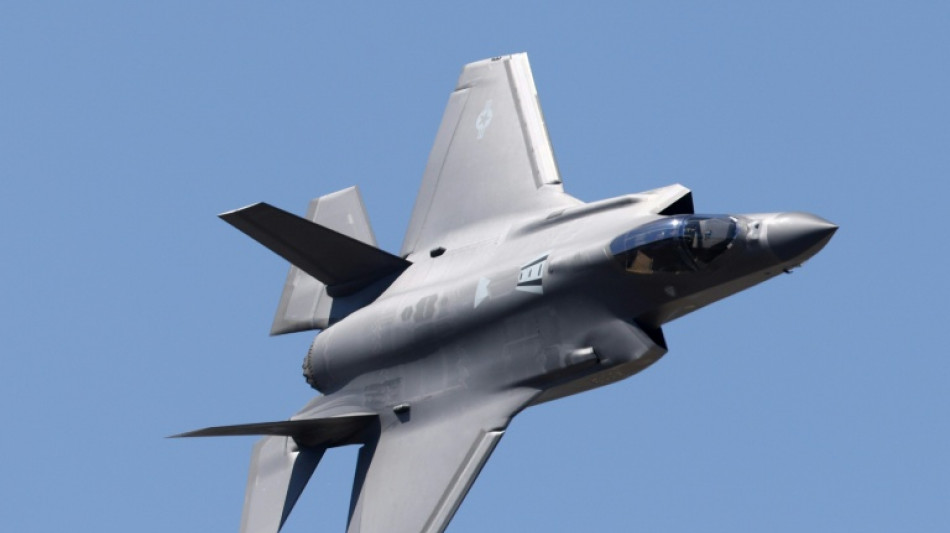
Missing F-35 fighter parts 'not sensitive', says Australia minister / Photo: Toby Shepheard - AFP/File

Missing F-35 fighter parts diverted from Australia to Hong Kong are not "sensitive", Defence Minister Richard Marles said Tuesday, confirming Canberra was helping to investigate the incident.
The United States operates more than 800 F-35 jets, its most costly weapons system, which is also flown by many of its defence allies, including Australia.
News outlet Politico said a shipment of F-35 parts, including a canopy with radar-resistant technology, had been unexpectedly diverted to Hong Kong after leaving Australia, raising the possibility that China had accessed the weapons system.
Marles confirmed the incident to reporters on Tuesday, saying Australia was working with the United States and its prime contractor for the F-35 programme, Lockheed Martin, in an investigation.
"We are examining very much everything that has occurred at the Australian end," Marles said, adding that Canberra was "confident about the way in which we've engaged with the programme", without elaborating.
"We're not talking about sensitive equipment here or sensitive parts. Ultimately, though, this is an issue which is going to be managed by the United States and by Lockheed in terms of what has occurred."
Lockheed Martin was responsible for managing the F-35 global supply chain, Marles said.
Australia has 72 F-35 jets, and is among seven countries outside the United States sharing a global pool of spare parts, including Canada, Denmark, Italy, the Netherlands, Norway and Britain.
Another 12 countries have purchased the fighter jet, including Japan, Singapore and South Korea.
Politico said Lockheed Martin had used a third company to ship the components, which were bound for the United States but ended up in Hong Kong instead.
The Politico report on Saturday said it was unclear why the equipment was rerouted or who now held it.
A warehouse in Williamtown, near the city of Newcastle north of Sydney, operates as an Asia-Pacific regional hub for F-35 spare parts.
Australia's parliament heard last year how F-35 parts were moved in and out of the warehouse by Lockheed Martin, destined for other parts of the world, and placed on commercial aircraft with stopovers in Asia.
Australia did not control or direct the export of the F-35 parts from the warehouse, defence officials said last year.
Two sources told AFP the programme was controlled by the US military.
The warehouse was designed to support F-35 jets in Singapore, Japan, and South Korea, as well as US and British aircraft carriers deployed in the region.
Lockheed Martin Australia said it could not discuss its shipping procedures for security reasons, but every shipment was handled with "utmost diligence" and followed "all US regulations established by the Department of War".
T.Nystrom--StDgbl