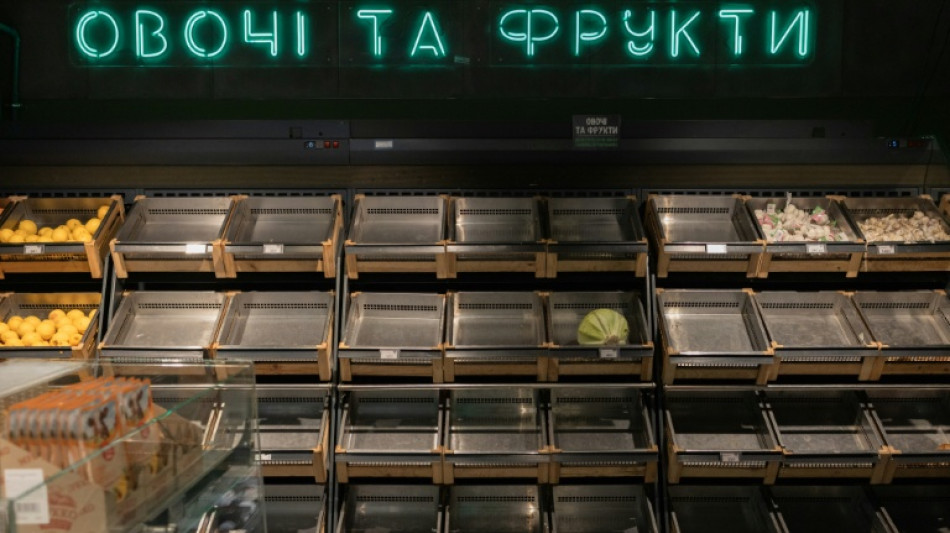
Kyiv shoppers feel the pinch from Russian strikes / Photo: Roman PILIPEY - AFP


With one eye on the shelves and the other on his phone, Maksym Tarasenko has gotten used to keeping an eye out for Russian drones above Kyiv as he shops.
But Tarasenko, 26, is unable to feed his caffeine habit, as his favourite fizzy drink is no longer in stock at his local supermarket. "There's absolutely no Coca-Cola left, not even the equivalent," he said.
Last month, he said the Silpo store where he shops had no potatoes, cereals or many vegetables.
In the last nine months, there have been three times as many airstrikes on civilian warehouses in the Kyiv region than in the first four years of Russia's invasion in February 2022.
Two-thirds of them have happened since the start of August, according to an AFP analysis of data from the ACLED conflict monitor up to September 18.
Ukraine's food minister, Taras Vysotskyi, has said the wave of attacks has "seriously disrupted, even rendered inoperative" the supply chains used by major retailers, which are based on centralised logistics platforms.
He called on brands to decentralise their logistics, focus on short-term supply chains and use smaller warehouses or ones located in neighbouring countries.
- Supply chain -
The Fozzy group, which owns Silpo, announced in early August that it was reorganising its supply chains, allowing shelves to be restocked, albeit without some brands.
With fruit carefully stacked, a slew of special offers and light music, everything might appear normal.
But clients are glued to their devices: above the capital, thick black smoke rises after a Russian strike on a market near the city's central station.
For Tarasenko, Moscow is trying to create "widespread panic" among citizens.
The first shortages prompted a rush on certain products as residents sought to stock up before winter, he said, but he is remaining calm.
"A little market has been set up near where I live. I sometimes buy basics there, it's a little bit cheaper," he said.
And if the situation gets even worse, he has already found a grower in the provinces where he can get his potatoes.
- Inflation -
In the Kyiv suburbs, about 10 kilometres (six miles) from the supermarket, firefighters busy themselves around a huge skeleton of charred metal.
Bottles of oil, packets of salt and a few tin cans lie among the debris. Just the day before, the building was being used as a warehouse for the ECO Market chain.
According to Oleg Pendzyn, an economist, these types of Russian attacks have caused an estimated deficit of 1.3 billion euros ($1.5 billion) for the Ukrainian state.
Vysotskyi, the food minister, has warned that the reorganisation of logistics could increase the cost of foodstuffs by up to 2.5 percent, while Ukraine's central bank said annual inflation stood at 8.1 percent in August.
"It's hitting my wallet hard!" said Anya Dmyterko, a 35-year-old vendor at the market in Boryspil, outside Kyiv.
"With 1,000 hryvnias ($22.20), I could buy food, meat, treats for the kids," she said. "Now, you can hardly buy anything."
As the sirens screamed again at the central market in Boryspil, Dmyterko pushed her own shopping trolley without looking up.
Since August, the smell of burning has filled the air around the small town surrounded by warehouses, making it a prime target for Moscow.
In the evening, when the drones approach, Dmyterko said she quickly grabs her three children and they head to the basement.
- Essentials -
Despite the threat from above, life continues at the Boryspil market. In Dmyterko's shop, new customers arrive as her shelves have not been as badly hit by shortages and inflation as bigger supermarkets.
Most Ukrainian families buy 45 percent of their products at markets every month, said Pendzyn. Thirty percent is spent in local grocery stores.
Such stores source their supplies directly from domestic producers, a set-up that, for now, eliminates any risk of food shortages, he added.
Supermarkets are mostly used by "the young urban population with comfortable incomes", the economist added.
Pendzyn said he was particularly worried by Russian strikes on the Black Sea ports, because Ukraine depends on them for 90 percent of its exports and no land route can absorb such a volume.
The sound of anti-aircraft guns pierces the sky as conversations at the market revolve around rising prices and the coming winter.
Dmyterko lines up jars of gherkins and tomatoes.
"The main thing is that there's food and water," she said. "No Coca-Cola is not a disaster."
Q.Lindgren--StDgbl