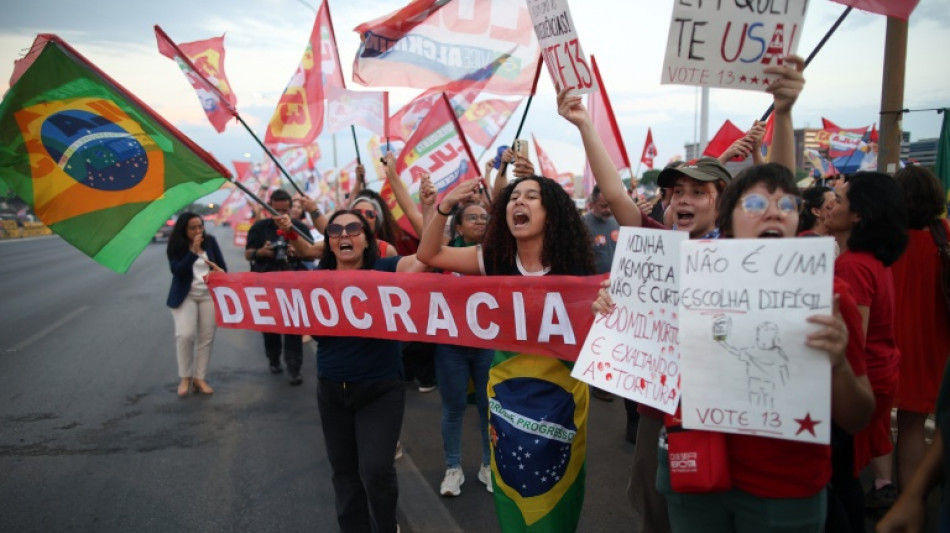
Brazil's left rallies as Lula closes gap before runoff / Photo: Sergio Lima - AFP
Brazil's left has mounted a political fightback ahead of the October 25 presidential runoff, rallying supporters in the streets, overhauling its social media campaign and pushing through a landmark labor reform.
President Luiz Inacio Lula da Silva, 80, was jolted when he finished behind right-wing Senator Flavio Bolsonaro -- son of former president Jair Bolsonaro -- by 47 percent to 45 percent in the October 4 first round.
But a Datafolha poll published Thursday showed Bolsonaro's lead in the runoff narrowing from four percentage points to two, putting the rivals in a statistical tie.
Bolsonaro was on 51 percent of valid votes against Lula's 49 percent, within the survey's two-point margin of error.
Seeking a fourth term, Lula is now targeting the 33.4 million Brazilians who stayed away from the first round -- more than one in five eligible voters.
"Lula is still in the race, and the election is far from decided -- despite what many of us thought after the first round," political scientist Eduardo Grin of the Getulio Vargas Foundation told AFP.
- A shorter working week -
Congress approved a constitutional amendment Wednesday abolishing Brazil's six-day working week, a flagship Lula campaign promise that will give employees two paid days off without cutting their wages.
The reform will replace the widespread "6x1" system -- six days of work followed by one day off -- with a five-day week, gradually reducing the maximum working week from 44 to 40 hours.
The vote handed Lula, a former trade union leader, a major victory just 10 days before the runoff, giving him a popular achievement to champion among working-class voters who have traditionally formed his political base.
The measure was so widely supported that even Bolsonaro, who had previously opposed it, voted in favor.
Lula attributed his rival's reversal to "pressure from society," hailing the reform as a victory born of the street protests demanding change.
The president has also unveiled debt relief for small businesses, new university grants and measures to ease fuel costs, while proposing free weekend public transport.
His government had already increased payments under Bolsa Familia, Brazil's flagship welfare program for low-income families, before the first round.
But the flurry of economic measures has raised concerns over government spending in a country whose public debt already exceeds 80 percent of GDP.
"The government is acting with zero fiscal responsibility," economist Marcos Mendes of the Insper research institute told AFP, describing the succession of benefits as potentially amounting to "indirect vote-buying."
- 'Selfie king' -
Lula has also shaken up a digital campaign he acknowledged was his most "disorganized" in decades, seeking to challenge the Brazilian right's formidable social media operation.
He has recruited young politicians with large online followings, including Ana Elisa, a 21-year-old newly elected lawmaker from Minas Gerais state who has millions of followers.
Lula has even dubbed himself the "selfie king," embracing informal, direct-to-camera campaign videos.
Long resistant to using a mobile phone, he has promised to buy one if a pro-Lula WhatsApp channel reaches five million followers.
The "Lula Army" has already attracted around 4.6 million.
Created by lawmaker Andre Janones, the channel assigns supporters online "missions" to spread campaign material and encourages ordinary users to share their own videos.
- Streets of red -
The left has meanwhile returned to the streets in force, staging demonstrations on a scale observers say Brazil has not seen in years.
Led by students and social movements, protesters dressed in the red of Lula's Workers' Party have marched under banners proclaiming "Bolsonaro never again" and "For democracy."
The demonstrators fear a return to the policies of Flavio Bolsonaro's father, far-right former president Jair Bolsonaro, whose 2019-2022 administration faced fierce criticism over its handling of the Covid-19 pandemic, attacks on democratic institutions and the rights of minorities.
Grin believes the demonstrations could play an important role in drawing voters to the polls.
"This rapid, mass mobilization in the streets has a multiplier effect and can undoubtedly bring out voters," he said.
X.Haglund--StDgbl