Serbia votes as ruling party faces ascendant student movement / Photo: Milos Milanovic - AFP



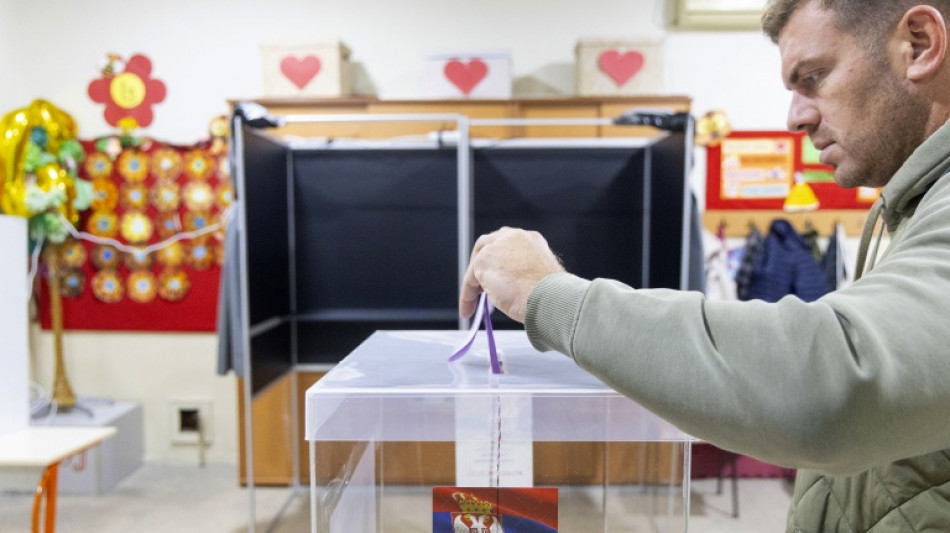
Voting was under way in Serbia on Sunday in what is set to be its most fiercely contested parliamentary election in more than 14 years, as a student-led movement seeks to oust the party of veteran leader Aleksandar Vucic.
The snap vote is the culmination of nearly two years of student-led protests sparked by the 2024 collapse of a canopy at Novi Sad railway station that killed 16 people -- a tragedy widely blamed on corruption.
The disaster triggered some of Serbia's largest protests since the fall of strongman Slobodan Milosevic in 2000.
The Students' List, a selection of candidates backed by the largely leaderless movement, now poses the biggest challenge to Vucic's right-wing populist Serbian Progressive Party (SNS), which has dominated politics throughout its tenure.
- High turnout -
Eighteen electoral lists are vying for seats in Serbia's 250-member parliament, but polls suggest voters will largely choose between the ruling party and the student-backed list.
Several leading opposition parties have opted not to run, instead urging their supporters to back the students.
An unusually high turnout is expected among Serbia's 6.4 million registered voters, with the central election committee recording an almost doubling of early turnout figures from last election so far.
The commission said by 10 am almost 20 percent had already cast ballots compared to 9.94 per cent in the 2023 elections.
In the decades since Milosevic fell, when around 70 percent cast ballots to oust him, parliamentary turnout has declined, averaging just above 55 percent during SNS rule.
At many polling stations, long queues formed before doors opened at 7.00 am (0600 GMT), with thousands lining up in Belgrade and across the country.
Videos posted online also showed Serbs abroad turning out to vote -- from singing and dancing in the streets of Los Angeles to celebrations in a Toronto bar in the early hours, where polling hours followed the Serbian time zone.
Long lines of cars also formed at the Croatian and Hungarian borders as the diaspora returned to vote.
For nearly two years, students have staged rallies and marched across the Balkan nation to reach voters directly and counter the SNS's media machine.
Their protests have regularly drawn huge crowds, with a final pre-election rally in Belgrade on Thursday drawing around 150,000 people to the streets, according to an independent protest monitor.
- 'Fighting for freedom' -
"Today, above all, Serbia is fighting for freedom and for the return of a country that has been hijacked," Dejan Bodiroga, a candidate on the Students' List and EuroLeague Basketball president, told reporters before casting his vote in Belgrade.
"Serbia has clearly sent a message which direction it wants to take. We're going all the way to victory! Students win!"
Vucic, who has also campaigned nationwide, embracing citizens in villages and towns, has repeatedly
"Serbia is voting today to decide which direction it will take -- towards the future or the past," he told reporters after voting at a Belgrade polling station.
Vucic early joined long queues to cast his vote.
"I expect a huge turnout ... and as I was always saying if we lose we'll concede it, if we win we'll keep it as it is and that's it, very simple rules for democracy," Vucic said.
- Political novices -
Most of the student list's 250 candidates are experts from fields including academia and the arts with little political experience.
The movement has a broad platform, centred on a pledge to fight corruption.
It evolved from demands for a transparent investigation into the Novi Sad tragedy into calls for an early election.
Against them is Vucic, the face of his party, who has tried to cultivate an image as an indispensable statesman, walking a diplomatic tightrope between the neighbouring European Union and his close ally Russia.
Under mounting pressure, the 56-year-old called the snap vote last month, citing "major turbulence on the domestic political scene".
The right-wing populist leader cut short his second presidential term to run for prime minister.
Days before the vote, Serbian civil society groups warned that conditions for "free and fair elections" were lacking.
Domestic and international observers will monitor the vote, with students mobilising large numbers of volunteers to oversee the process.
Polls close at 8:00 pm (1900 GMT).
C.Nordlund--StDgbl