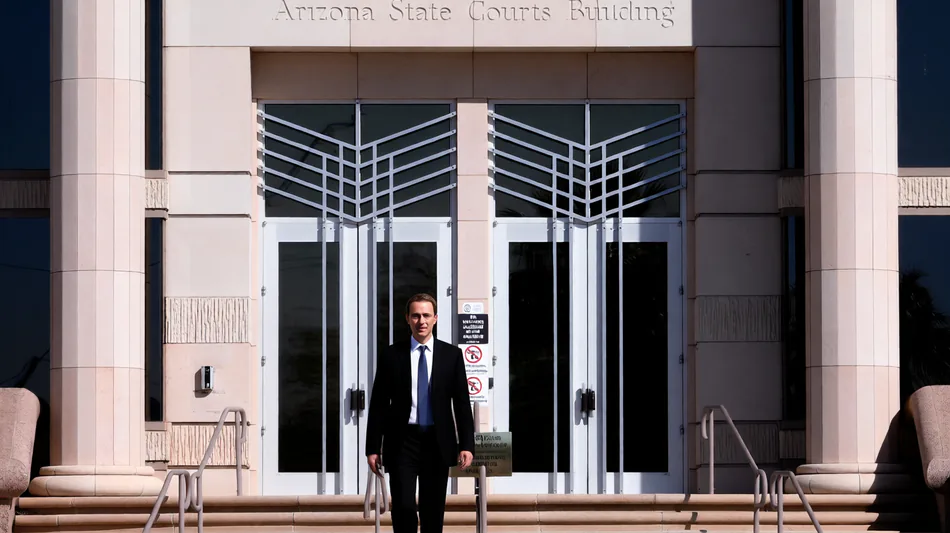
Three Arizona Judges Face Rare Defeat in Retention Elections



Three Arizona judges appointed by former Gov. Doug Ducey are facing rare defeats in their retention elections, with unofficial results showing all three trailing voters despite receiving favorable evaluations from the state’s judicial performance commission. The outcomes have sparked debate among legal experts regarding the future of judicial impartiality and the influence of partisan politics on the bench.
Three Arizona judges appointed by former Gov. Doug Ducey are headed for rare defeats in their upcoming retention elections, a significant outcome that could remove them from the bench despite receiving favorable evaluations from the state’s judicial performance commission.
Unofficial election results indicate that Arizona Court of Appeals Judge Anni Hill Foster is narrowly trailing with 50.2% of the vote against her retention, while Maricopa County Superior Court Judge Julie Mata is behind with 48.65%. Superior Court Judge Michael Rassas is also losing his race, with 49.4% voting to retain him.
The potential losses are notable because retention elections in Arizona rarely result in the removal of sitting judges. Since the current judicial review process began in 1992, only a small number of judges have been voted out of office. All three judges in question met the standards set by the Arizona Commission on Judicial Performance Review, which evaluates judicial conduct and competence ahead of each election cycle.
However, each judge faced targeted opposition from political groups and civic organizations citing concerns ranging from their past legal work to specific rulings. The opposition was not confined to a single political party. The Maricopa County Republican Committee encouraged "no" votes for all three judges, while the Maricopa County Democratic Party urged voters to reject Foster and Mata in its 2026 voter guide, though it did not specify reasons for its recommendations. Rassas was not included in the Democratic guide.
Civic Engagement Beyond Voting (CEVB), a group affiliated with the national progressive organization Indivisible, also encouraged voters to reject Foster and Mata. The group cited Foster’s role as lead counsel in former Gov. Ducey’s challenge to former President Joe Biden’s handling of COVID-19 relief funds and her representation of Ducey in an amicus brief for Dobbs v. Jackson Women’s Health Organization, the case that overturned the federal right to abortion. CEVB stated that the scope of Foster’s cases covered "objectionable perspectives" that compromised her impartiality.
Regarding Judge Mata, CEVB pointed to her handling of cases involving a ballot question on diversity, equity and inclusion and a proposed school choice measure. The group also noted that her judicial performance review showed "numerous red flags" in areas such as integrity and communication. For Judge Rassas, the group highlighted concerns about his temperament, citing that 21% of participating attorneys rated him as having "poor" or "very poor" temperament.
The results have raised alarms among legal experts who fear the trend could deter qualified attorneys from seeking judicial office. Will Auther, chair of the Commission on Judicial Performance Review, questioned the sustainability of the current system if retention becomes the norm for judges who pass performance reviews.
"At some point if it becomes the norm that three people every election cycle aren’t retained even though they passed the judicial performance review, who is going to want the job?" Auther asked.
Judge Rassas, appointed to the Superior Court in 2020 after serving as an assistant attorney general and administrative law judge, expressed respect for the voters' decision despite his lack of controversy or missteps. In a statement, he emphasized that judges should be judged on their work rather than political considerations.
"The voters have decided not to retain me, and I respect their decision, even though there was no ruling, controversy, or misstep behind it," Rassas said. "I am grateful I received high judicial performance review ratings from those who appeared in my court, and I hope everyone left my courtroom feeling heard." He added that a strong court system requires experienced attorneys willing to leave their practices to serve the public.
David Rosenbaum, an attorney at Phoenix law firm Osborn Maledon and board member of Arizonans for an Independent Judiciary, argued that Rassas’s work in family and juvenile court is not inherently political. He suggested that the electorate may not fully appreciate the importance of judicial independence.
"I don’t know that the electorate appreciates the importance to the state of judicial independence and impartiality," Rosenbaum said. "I don’t think they realize that judges are deciding cases based on the law and the facts before them. Particularly at levels below the Supreme Court … they don’t have political cases."
Judge Foster served as in-house counsel with the Arizona Department of Public Safety and as general counsel to Gov. Ducey before her appointment to the Court of Appeals in 2022. Judge Mata, appointed to the Superior Court in 2020, previously worked as an administrative law judge for the Arizona Department of Transportation and as a Superior Court commissioner. She recently oversaw a high-profile paternity case involving former "Bachelor" star Clayton Echard.
Neither Foster nor Mata responded to requests for comment regarding the election results.
The vacancies created by these potential losses will be filled through a process involving nominating commissions that make recommendations to Gov. Katie Hobbs for appointment.
E.Olsson--StDgbl