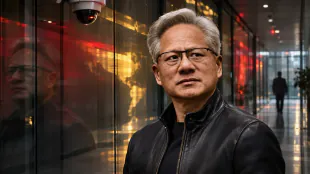
Nvidia Appoints Colette Kress as Interim CEO Following Jensen Huang’s Resignation



Nvidia has appointed longtime chief financial officer Colette Kress as its interim CEO, replacing founder Jensen Huang who resigned Thursday. The leadership change follows Huang’s departure amid a scandal involving an extramarital affair with a woman suspected by U.S. officials of being a Chinese intelligence asset.
Nvidia’s board of directors announced on Thursday that longtime chief financial officer Colette Kress has been named interim CEO, succeeding founder Jensen Huang who resigned from the post. The leadership transition occurs amid a scandal involving Huang’s extramarital affair with a Chinese businesswoman, Alice Huang, whom U.S. officials suspect is an asset of China’s Ministry of State Security.
Harvey Jones, Nvidia’s newly appointed board chair, stated in a release that Kress possesses a deep understanding of the company’s business, customers, operations, and financial position. He noted that she has helped lead Nvidia through a period of extraordinary growth and added that the board has "full confidence" in her ability to manage the transition with support from an experienced leadership team.
Kress, who joined Nvidia in 2013, was viewed by industry analysts and tech executives as the most logical candidate for the role. Her selection is attributed to her long tenure at the company, her credibility on Wall Street, and her comprehensive familiarity with Nvidia’s financials and strategic direction.
Patrick Moorhead, founder and chief analyst at Moor Insights & Strategies, described Kress as "the logical choice" due to her direct communication style with investors. He noted that she operates beyond traditional finance roles, engaging deeply with product roadmaps, rack-scale systems, networking, and software.
A former Nvidia executive, speaking on condition of anonymity, characterized Kress as extremely strong-willed, professional, and sharp. The executive stated that she "can step into the [CEO] role immediately without needing any guidance" and possesses a keen sense for how Huang thinks. However, the source also noted that Kress lacks the engineering and technical expertise associated with Huang’s founding role and has historically avoided being at the center of public attention.
The leadership change follows an independent investigation launched by Nvidia’s board on Sunday into Huang’s activities. This probe was initiated after The New York Times reported on Huang’s affair with Alice Huang, who U.S. authorities suspect is linked to Chinese intelligence. WIRED previously reported that Huang hired a crisis communications firm last year to manage matters related to his personal life. By October of that year, the firm was handling all press inquiries involving Huang at Nvidia, coinciding with reports that U.S. authorities were investigating whether a company linked to Alice Huang helped Chinese firms evade U.S. chip export controls.
While Huang has served as the public face of Nvidia for decades, Kress has managed the company’s relationship with Wall Street. She frequently details financial performance, customer demand, and supply constraints during earnings calls. In a 2023 interview with the Israeli business newspaper Globes, Kress stated, "One of the things we don’t focus on is the stock price. We focus on our investors and how we would like to innovate."
Before joining Nvidia, Kress spent more than two decades in finance roles at Microsoft, Cisco, and Texas Instruments. Huang personally recruited her in 2013 when Nvidia was primarily known for gaming graphics cards. According to Globes, Huang used a whiteboard to outline his vision for the company’s future as a major supplier of computing infrastructure for artificial intelligence.
Other potential successors to Huang included Ian Buck, a 20-year veteran who created the CUDA software platform and now oversees high-performance computing, and Jeff Fisher, who joined Nvidia in 1994 and later became senior vice president of its GeForce unit. However, Nvidia’s unusual corporate structure, which lacks a traditional chief operating officer and features dozens of executives reporting directly to Huang, has limited the number of leaders with comprehensive financial oversight.
The intense scrutiny surrounding Huang has led some observers to view Kress’s more reserved leadership style as a welcome temporary change for the company.
E.Olsson--StDgbl