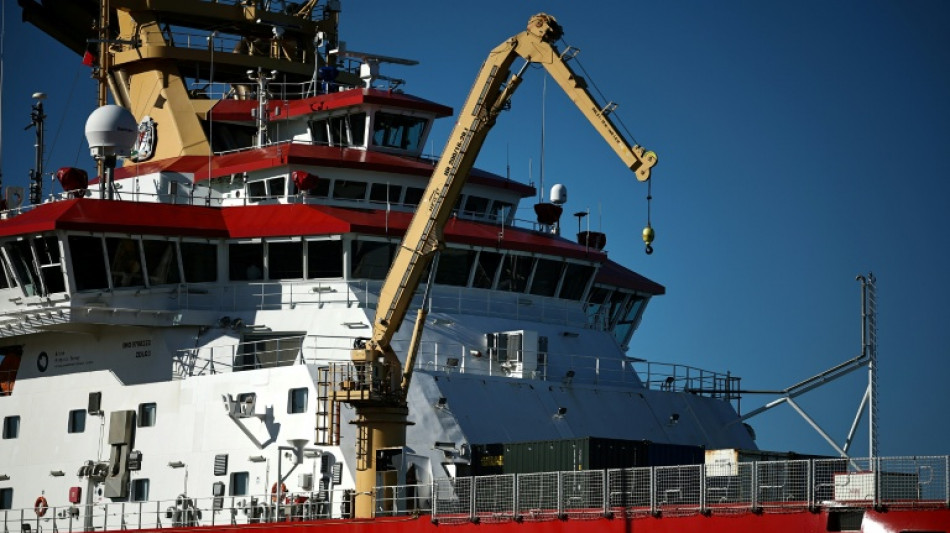
UK launches hi-tech mission to study Greenland ice melt / Photo: HENRY NICHOLLS - AFP



A team of international scientists sets sail Thursday from Britain for Greenland to study its rapidly melting ice using drones, mini-submarines and autonomous swimming robots.
Greenland's ice sheet, made up of millions of cubic kilometres of freshwater, is melting rapidly due to global warming, and scientists believe it could disrupt key Atlantic currents that control the world's weather.
But because of the hazardous environment, where blocks of ice "calve" or fall off unpredictably, scientists have struggled to study the melt up close.
The RRS Sir David Attenborough polar research ship, named after the famed British naturalist and television presenter, was leaving southeastern Harwich with dozens of international scientists on board.
The £20-million ($27-million) project, led by the British Antarctic Survey, is funded by the UK government.
For around five weeks, the scientists will sail in fjords that fringe southeast Greenland, studying glaciers from all angles.
They will fly drones with high-resolution cameras and lower autonomous robots that can dive hundreds of metres to the seabed and screw themselves to the ice wall.
"Marine robots can go right up against the ice... where people cannot go because it would be completely unsafe for them," said project leader Kelly Hogan, a marine geophysicist.
The team wants to capture granular details because scientists still "don't really understand how the ocean water melts the ice", said British marine physicist Mark Inall.
Scientists see signs that huge volumes of melting Greenland ice are affecting the powerful currents that move hot and cold water around the Atlantic and help to regulate the climate.
The current UK climate change model for the next century forecasts disruption of one such current, the North Atlantic Subpolar Gyre, within decades, affecting regional fisheries and marine life.
"Our best models at the moment say these changes could happen as early as the 2040s," said Hogan, a scientist at the British Antarctic Survey.
But she told AFP these simulated scenarios are known to have inaccuracies and the expedition aims to "get the melting Greenland ice sheet really well represented in the models".
"We are directly feeding into the UK's best model for climate prediction, so I think we can make a real difference to that," she said.
An ocean scientist who specialises in modelling data, Paul Holland, also from the British Antarctic Survey, will be on board to work directly with the findings, as the "problem is so urgent".
"We don't have time to just wait for scientists to do all of this and then wait for the climate modelling centres to catch up," he said.
- 'Huge uncertainty' -
Holland cited the potential role of the melting Greenland ice on the Atlantic Meridional Overturning Circulation (AMOC), a vast ocean current system that functions as a kind of conveyor belt, regulating the global transfer of heat from the tropics into the northern hemisphere.
Scientists broadly agree the AMOC is weakening because of accelerating Greenland melt-off, but debate persists over how fast this is happening and whether the system could collapse this century.
A shutdown would have dire consequences, including much harsher winters in northern Europe and higher sea levels around the North Atlantic.
For Holland, there is "huge uncertainty", but "we know for sure that increasing greenhouse gases is making these worse outcomes more likely".
"We can still make a difference in terms of the precise impacts and the exact likelihood of AMOC shutdown," he said.
Some scientists have suggested the AMOC's collapse is already inevitable, but "that is not at the moment the consensus view," said Inall.
"It seems like the AMOC is slowing down, and that's probably going to continue," US glaciologist Erin Pettit told AFP.
"But exactly how much impact (this) will have is part of what we're hoping to figure out."
M.Bengtsson--StDgbl